

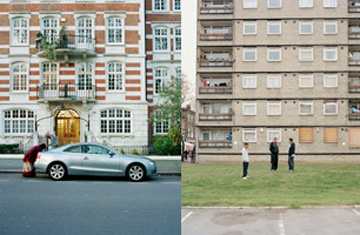
Have and have not London ranks as one of the most unequal cities in the developed world
The front window of the grocery store off Lisson Grove lets in very little light, covered as it is with receipts taped to the glass. Each slip documents a bit of credit extended by the shop — a few dollars to one customer for a half-kilo of meat, a few more to another for bread and eggs. The dozens of receipts add up to nearly $500 — testimony to how dire the economy is in this North London neighborhood. "It's very bad now," says owner Ali Farhat, who says that he turns away job seekers several times a day and that business has fallen 30% in the past two years.
The squeeze on low-income neighborhoods like Lisson Grove has set off a torrent of debate in Britain about who is to blame for the worsening condition of the lower and middle classes in the wake of the Great Recession. Partisan wrangling has only intensified since last year, when Archbishop of Canterbury Rowan Williams attacked the country's coalition government for drastic cutbacks that treated the lower classes like the "undeserving poor," a phrase made famous by Eliza Doolittle's father, a resident of Lisson Grove in the 1912 play Pygmalion.
The dustman's daughter taught to speak like a duchess was George Bernard Shaw's fantasy figure of Edwardian class divides — divides that are making a comeback. With 95% of the neighborhood's children living in poverty, the area ranks among England's poorest. Half a kilometer away is St. John's Wood, home to bankers, football managers and former Beatle Paul McCartney. Up there, you wouldn't know Britain was facing the biggest squeeze on living standards since the 1920s: the local deli sells apricots for $80 a kilo, a flat can run you $9,600 a week, and the credit crunch doesn't seem to have deterred shoppers for the area's "midrange" houses, which cost $10 million to $16 million.
There's nothing new about wealth and poverty occupying the same square kilometer of London. What's changed in recent decades — and what's been growing more acute since the 2008 global financial crisis — is the scale of that inequality. London's Gini score — which ranks an area's wealth inequality on a scale of 0 to 100 — rose from about 34 in 2002 to over 36 in 2010 — significantly above the Organisation for Economic Co-operation and Development average of about 32. With the top 10% of the population worth 273 times the bottom 10%, London ranks as one of the most unequal cities in the developed world, trumping even New York City, notes Danny Dorling, an expert in urban inequality at the University of Sheffield. The rise in income inequality in Britain — the fastest growing in the OECD over the past three decades — is largely due to the dramatic growth of the City, London's financial district, since the industry was deregulated in 1986 to compete with Wall Street. That's partly because Britain's economy is more dependent on London's financial district than the U.S.'s is on Wall Street. The U.S. economy is "five to six times the size of Britain's, and the City of London is five to six times more important to Britain than Wall Street is to the U.S.," says London School of Economics professor Brian Bell. It's also because of geography. London, a prime destination for Asian, Russian and Middle Eastern riches, has a higher concentration of foreign and domestic wealth than New York, especially now that rich refugees from the euro crisis and the Arab Spring have poured money into central London.
That makes the capital city its own ecosystem within the British economy: its citizens pay nearly 7% more for goods and services than Britons elsewhere and 80% more to rent property. But everything that happens in London doesn't stay in London. The prime drivers of Britain's rise in overall inequality since the mid-1990s are twofold: inequality in London and the inequalities in the financial sector, according to research by Mark Stewart, an economist at the University of Warwick. London also has a bigger monopoly on Britain's wealth than New York has on the U.S.'s, since more wealthy Americans are spread across the country and across industries outside finance. Though inequality in British earnings had been rising since the late 1970s, the process of widening stopped by the mid-'90s — with the exception of the top end, which was driven primarily by the financial sector. "There's been a decoupling of the financial sector from the rest of the economy," explains Stewart. "It's also been decoupled from changes in productivity, or GDP per head. Most of the financial benefits have accrued to the top of the income distribution."
It doesn't help that British taxes have become less progressive. In the early '70s, the top income-tax rate was 83%; it's now 50%, having been 40% for two decades. Unequal, too, is the distribution of the spoils of Britain's prosperity boom over the past decade, which has benefited the better heeled. Across England and Wales, properties valued at over $800,000 account for just 4.5% of all housing but nearly 18% of the market's value, according to the real estate company Savills. Except in St. John's Wood and a handful of similarly posh London neighborhoods — where top-end property prices rose 38% from 2009 to 2011, according to research from the real estate firm Knight Frank — property prices have fallen by about 5%. Despite this, tightened credit and frozen wages mean that younger Britons in particular are increasingly priced out of the real estate market. In depressed areas like Lisson Grove, it is the double blow of high unemployment and public-spending cuts that wounds the most. "The austerity program has been a significant drag on growth in recent quarters," observed a report from the respected Institute for Fiscal Studies earlier this year.
As Britain's rich have become richer, flush bankers with bonuses have practically struck gold. The London School of Economics' Bell and John Van Reenen have charted how the growing gap in British wages over the past decade has come from the top few percentiles of earners. All the gains for the top 5% of British workers from 1998 to 2008, they found, were a result of hikes in bonus pay for people in finance. "About 60% of the increase in [Britain's] extreme wage inequality," they observed, "is due to the financial sector."
Britons in the low- to middle-income bracket, whose earnings were flat even during the boom years, now have the recession to blame for an 8% fall in incomes, according to a recent report from the London-based think tank Resolution Foundation. Two-thirds of Britain's low and middle earners say they're struggling to keep up with daily bills; nearly half say they can't afford an annual holiday. Martin Cable, an unemployed floorer from Lisson Grove, certainly can't, not on the $103 Jobseekers' Allowance that must last a week for his family of five. "That only gets you past the first three days," says the 26-year-old. "Ten pounds [16 dollars] on gas, £10 on electricity and the rest on filling the cupboards." He's never claimed benefits before, but in just three weeks on the dole, he's already had to stretch his welfare check with a $93 payday loan. Over the past two years, Britain's Citizens Advice Bureau says it's seen a fourfold rise in these sorts of few-questions-asked payday loans, whose APRs can reach 3,000%.