

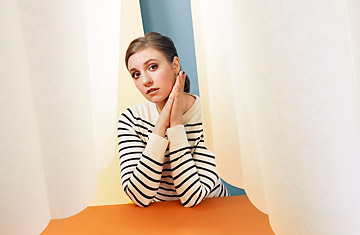
"There is something a little bit ironic about calling 24-year-old women 'girls,'" Dunham says. "But at the same time, I don't think they would self-identify as 'women.'"
(2 of 3)
HBO bit, and Dunham joined with executive producers Jenni Konner and Judd Apatow. Apatow--who brought you such dudely comedies as Knocked Up--might seem an odd partner. But he also produced Bridesmaids, and his TV series (Undeclared, Freaks and Geeks) have a naturalistic, improvisational style that resembles Dunham's work. Apatow says he was "blown away" both by Furniture and Dunham's easy confidence. "Her parents are artists," he says, "so there's no neurosis about the creative process for her. When she goes to write, it's like she's going on vacation. Most writers look like they're going into the depths of hell."
Girls is more structured and less precious than Furniture, with more concrete stakes and less matter-of-fact privilege. Dunham plays Hannah Horvath, a would-be essayist and unpaid intern whose parents visit from the Midwest and announce that they're no longer going to pay her bills. Two years out of college, she's out of the nest and has to start flapping her arms, fast. She's also in an about-75%-bad relationship with Adam, a pretentious, occasionally sweet hipster (Adam Driver) who answers a request to use a condom with "I'll consider it!"
Hannah's three best friends each represent different career and romantic stages. Her roommate Marnie (Allison Williams) has a stable job and a perhaps too-stable longtime boyfriend; worldly Jessa (Jemima Kirke) has blown back into town from her most recent adventure; Jessa's cousin Shoshanna (Zosia Mamet) is a naive wallflower who substitutes life experience with a self-esteem-oriented dating book, most of whose conclusions are "That's unacceptable, ladies!"
You may recall that HBO once aired another little show about four women in New York City. Girls steers into the Sex and the City comparison--Shoshanna calls Jessa "a Carrie, with some Samantha aspects and Charlotte hair"--but is its own thing: Greenpoint, Brooklyn, not the West Village; ratty couches, not shoe closets; cringe humor, not vibrator puns. And Hannah doesn't resolve each episode with a voice-over and an overworked metaphor. Girls tolerates a mess.
Hannah is not Dunham, but she's also not not Dunham; she even has the same tattoos, with the same backstories. (One of them, which Hannah credits Jessa with giving her, is the handiwork of Kirke, Dunham's friend from private school.) Like Woody Allen (in Tiny Furniture, Aura reads Without Feathers) or Louis CK, Dunham is terrific at performing variations on herself. She plays Hannah's literary aspirations for comedy, like when Hannah asks her parents to run her tab a little longer while she's psychosomatically high on a cup of weak opium-pod tea: "I don't want to freak you out," she says slowly, "but I think I may be the voice of my generation. Or at least a voice, of a generation."
Dunham credits Konner with whispering that line to her on set. Like most TV, Girls is collaborative, but it also feels like the product of Dunham's eye and voice. It may get as much attention, though, for how much of her body Dunham puts into it--like the explicit sex scene in Episode 2 when role play between Hannah and Adam goes awkwardly, sidesplittingly awry. (Dunham has taken some cheap shots for daring to appear naked onscreen looking like a normal human woman who occasionally eats a damn hamburger.)