

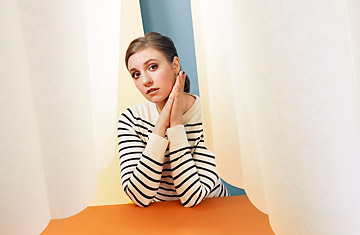
"There is something a little bit ironic about calling 24-year-old women 'girls,'" Dunham says. "But at the same time, I don't think they would self-identify as 'women.'"
The last time Lena Dunham was at the South by Southwest film festival, at age 23, plugging a (literally) homemade indie film with flyers from Kinko's, she did a sit-down with the New York Times in which she mentioned, among other things, that she was a macrobiotic vegan. Two years later, we're in the same hotel caf, and Dunham is here with HBO, which has commandeered seemingly every surface in town to promote her new comedy series, Girls (premiering April 15 at 10:30 p.m. ET). She orders a hamburger, medium rare.
I order the same burger and mention her Times quote. "Yeah, that was a pretty amateur move," she says with a laugh, remembering that it led to an awkward encounter with actress Natalie Portman after Dunham went carnivore again. "She said, 'I hear we're both vegans,' and I was so embarrassed that I was like, 'Yes! We're both vegans!'" Dunham was so racked with guilt that she later "bum-rushed" Portman to confess.
The problems of Girls' emerging adults--STD scares, student-loan debt, bad relationships, worse career options--are far removed from Hollywood faux pas involving Queen Amidala. But the incident captures the spirit of Dunham's raunchy, brilliant, brutally honest comedy about coming of age smart and female in New York City. Amateur moves. Tried-on-for-size identities. Grand declarations, later amended. Rookie mistakes, postmortemed with self-aware humor. Delightful embarrassments.
The archetypal HBO show creator is a gruff, blustery, high-art white dude on the far side of 50, given to grand themes and frequently named David (Milch, Simon, Chase). Dunham, 25, is quippy, self-deprecating and pop-culture-immersed, and practically lives on Twitter. (Sample: "That moment when Nyquil hits feels like being licked by an orchestra.") She does have a high-art background, as the daughter of photographer Laurie Simmons and painter Carroll Dunham. But where the typical HBO auteur sought to remake TV in the image of '70s cinema, Dunham is glad to let it be TV. "The Sopranos started when I was in seventh grade," she says. "I don't remember a time when TV wasn't art."
You could argue that Girls is another example of HBO's modeling TV on film--in this case, indie film. Having made some YouTube videos, an undergrad feature at Oberlin College and an online art-world parody (Delusional Downtown Divas), Dunham wrote, directed and starred in Tiny Furniture a year out of college. She played Aura, a budding filmmaker, just graduated, who has moved back in with her photographer mom (played by Simmons, who lent her SoHo loft for the location). Aura bounces among unrewarding relationships and makes selfish decisions, making for an unsparing but empathetic portrait of the artist as an entitled young woman.
Tiny Furniture won the Narrative Feature prize at South by Southwest, and HBO called Dunham for a meeting, though she says she didn't have a script to pitch: "I said, 'Here's the kind of show I would want to see. Here's what my friends are like. They don't have jobs, but they're really smart. They take Ritalin for fun, but they're not that f---ed up. They're having these kind of degrading sexual relationships, but they're feminists.'"