

(2 of 4)
Monti ended up in this position through one of the more unusual twists in modern European governance. His predecessor, the colorful Silvio Berlusconi, had dominated Italian politics for a decade, but as the crisis spiraled in late 2011, he proved unable to rally the country's politicians to tackle it. Discredited, Berlusconi resigned in November. The failure, though, was not his alone. Italy's political establishment woke to the reality that partisan politics had failed the nation. The left and right "are both incapable of doing the reforms," says Pier Ferdinando Casini, leader of the Union of the Center political party. "We are afraid of losing votes."
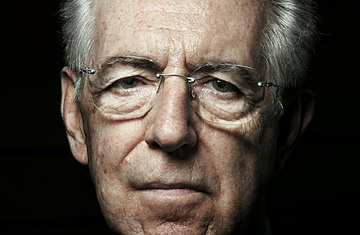
The solution was Monti. Italy's President, Giorgio Napolitano, called on him to step in and run the government. The Yale-educated economist was president of Milan's Bocconi University, and he had studiously avoided the corrupting influence of Italian domestic politics throughout his career. But, he says, the request to serve came "at such a severe time of crisis for Italy that I could not refuse."
Today he reigns over Rome like a new Caesar. In effect, the democratic process has been suspended to allow an unelected technocrat to implement policies that elected politicians could not. Monti calls it a "temporary mutual disarmament" of the left and right. Nearly all the major political parties set aside their differences and threw their support behind him, and that has given Monti almost uncontested control of the nation's decisionmaking.
He has used his mandate to the fullest. In December he implemented a biting austerity program of tax hikes and spending cuts, aiming to balance the budget by 2013, and a reform of the country's pension system with phased increases in the retirement age. In January he announced a sweeping liberalization of professions that are regulated and protected from open competition, like pharmacists, taxi drivers and lawyers. Next on the agenda is a major overhaul of the distorted labor market to make it more flexible and create jobs for the nation's army of unemployed youth. His efforts have already had an impact. Bond yields have fallen by about 1.5 percentage points since Monti took charge, to (a still elevated) 5.6%, easing fears of an imminent European meltdown.
Conflicts with Interest
Not everyone is enthralled, of course. Monti is taking on entrenched interest groups that have repeatedly defended their privileges, and they're not going down without a fight. Taxi drivers staged strikes in Rome and other major cities. Pharmacists are threatening to do the same. Truckers blocked roadways to protest a fuel-tax hike. To these constituencies, Monti's reform agenda is radical, even dangerous. "In Italy, the economy was more based on rules that used to be applied to create wealth for the general public," says Loreno Bittarelli, president of Uritaxi, a national taxi union, which is opposed to Monti's program. "I don't understand why suddenly the only solution [to the crisis] is to get rid of the rules." His enemies see him as an elitist who is unsympathetic to the struggles of middle-class Italians. "Monti has always lived in the salons," says Bittarelli. "He really doesn't know the problems of ordinary people."