

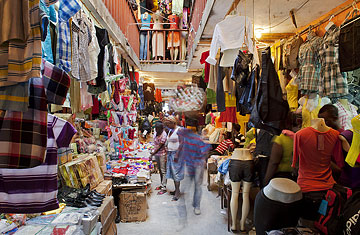
Market Demand To help restore Haiti's economy, larger loans are needed
(2 of 2)
Sadly, microcredit's ability to accomplish its main mission — ending poverty — has also come under challenge. It occurs only sometimes and under certain circumstances, says David Roodman, a senior fellow at Washington's Center for Global Development, who analyzed the experiences of hundreds of microcredit clients over several years. His findings, published in December in a book titled Due Diligence: An Impertinent Inquiry into Microfinance, highlight one critical deficiency: the industry's preference for lending money to the very poorest people. In fact, U.S. law mandates that half of all microcredit funding from Washington go to the very poor — a mistake, according to Roodman. He says the poorest people tend to use their loans to pay for basics like doctor's bills and school fees rather than to build microenterprises. And with median interest rates of 30%, poor clients rarely build up capital. Says Roodman: "The best estimate we have of the impact of microcredit on poverty among clients is zero."
It was not supposed to be that way. When Yunus began Grameen in the 1970s, he was convinced that millions could escape poverty with loans as small as $25. In a model since replicated across the world, Grameen organized women into five-member groups to jointly assume debts, aiming to break the grip of loan sharks who'd long exploited Bangladesh's deep poverty. With the help of intense peer pressure, the rate of repayment was exceedingly high, and Grameen still claims to have a whopping 95%-to-98% repayment rate. In many microcredit programs, interest rates can top 60% on a six-month loan, largely because these small, short-term loans remain costly to manage, with loan officers traveling across remote areas to meet borrowers. Grameen itself, hugely profitable, became an independent bank in 1983. Its operating income in 2010 exceeded $100 million. No surprise, then, that Grameen is cited as proof of microcredit's giant potential.
To Roodman, saving is a much better antipoverty strategy than borrowing, but many microlenders naturally push borrowing because they depend on loans for income. That conflict of interest has a price. "The more money we lend to microfinance [clients], the more they can say, We don't have to worry about savings," he says.
As microfinance institutions increasingly began to resemble big businesses, a backlash became inevitable. Nicaraguan microlender Banex went into liquidation in 2010 after borrowers revolted against high interest rates. In addition, runaway growth has led to bubbles, which are bound to burst. The most spectacular collapse came in India's Andhra Pradesh state, where about 40 microcredit institutions chased the same customers, who took on multiple loans. Unable to repay debts, a spate of borrowers committed suicide in 2010. The state government — itself heavily invested in microcredit — ordered microcredit institutions to suspend their operations, putting many livelihoods in jeopardy. "Microfinance was a victim of its own success," Roodman says. "For a while everything looked great because there were a lot of new lenders. But of course, it had to end."
Ironically, the scandals could ultimately leave microcredit in better shape. Shaken by the collapse in Andhra Pradesh, the Reserve Bank of India recently imposed an interest-rate cap of 26% on microcredit organizations, a move heavily criticized by the industry, which fears it could stifle profits and tighten credit for poor Indians.
For now, such government curbs are rare. Instead, organizations are overhauling their operations, determined to survive the shakeout. Thanks to the huge proliferation of mobile-phone banking, groups in Kenya, Tanzania, Rwanda, Pakistan and India have begun mobile-payment schemes, drastically reducing their costs. And since the 2008 recession, dozens of organizations have begun to finance themselves by offering savings accounts, seeing them as a more reliable source of capital than foreign investment because saving "tends not to go away during global financial crises," says Larry Reed, director of the nonprofit Microcredit Summit Campaign in Washington.
In Haiti, where hundreds of thousands are still homeless from the 2010 earthquake, Fonkoze last year started the country's first catastrophic-insurance plan, underwritten by Swiss Re and the aid organization Mercy Corps. The plan can allow businesses to get on their feet quickly in the event of another natural disaster.
Curiously, one of the biggest players in the industry remains the organization that began it all: Grameen. Yunus no longer runs it, since his fame apparently made him a threat to Bangladeshi Prime Minister Sheik Hasina Wajed. Last March, she removed him as head of Grameen on the pretext that he was past the legal retirement age. Grameen officials insist the move was politically motivated; Yunus remains on its board. He says his battles back home have not prevented him from traveling the world as microcredit's leading visionary — a role he says still surprises him. "When I started, I was only trying to solve a local problem," Yunus wrote to TIME. "I had no idea one day it would grow to be a nationwide program or a global program, but this is the reality now." It's also the reality that the world isn't going to run out of poor people anytime soon — or, apparently, of institutions willing to lend them money at a price.