

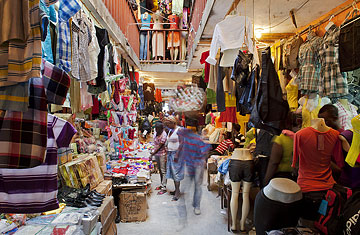
Market Demand To help restore Haiti's economy, larger loans are needed
These days, Yanick Mézile darts between her demanding job as Haiti's new Minister for Women and her wholesale business, where her six employees sell goods to a city ravaged by the devastating earthquake two years ago. On Saturdays, Mézile oversees the work in Port-au-Prince's hectic marketplace, doing a brisk trade in luggage, school supplies and dozens of other items. "Things were really bad after the quake," she says, "but I'd say I am more or less back to where I was before."
In a country still struggling to recover, Mézile is a standout. Yet it could have just as easily gone another way. When Haiti's quake hit in January 2010, killing about 85,000 people and leaving a million homeless, the warehouse where Mézile stored much of her merchandise was crushed. With little means to support her family, Mézile appealed to government officials and aid agencies to help restock her business and was told it would take months. So she turned to Fonkoze, Haiti's biggest microfinance institution, even though its loans were typically about $100, a sliver of what she needed.
Mézile's request was well timed, and she was able to borrow $50,000. Fonkoze had begun rethinking its strategy of lending tiny amounts to many poor people — the long-held tradition for microcredit. "For years everything was about very, very small loans," says Georgette Jean-Louis, who was then Fonkoze's chief operating officer and who now sits on the board of Haiti's central bank. "But we realized that if we were really going to have an impact, we needed to go a step up."
Fonkoze was not alone in its rethinking. As microcredit has ballooned into a global industry, it has undergone a shake-up, with institutions, investors and aid agencies questioning whether the model is meeting its mission of ending poverty by giving small loans to start microbusinesses; after all, more than a billion people still subsist on about $1.25 a day, according to the World Bank.
The emerging model of microfinance is broader and less micro. It's one in which for-profit institutions are making bigger loans and focusing less exclusively on women. The idea is to foster larger, more sustainable enterprises that can create wealth at a faster pace, lifting more people out of dire poverty.
By one metric — expansion — microcredit has been a roaring success. Since 1976, when the Bangladeshi economist Muhammad Yunus opened one of the first modern microcredit institutions — the Grameen Bank — more than 3,600 similar organizations have been established, operating in virtually every corner of the world. Yunus' model won him the 2006 Nobel Peace Prize. In 2010, institutions lent more than $70 billion to nearly 100 million people, most of them women — a ninefold increase from just 11 million people in 2000, according to the Microfinance Information Exchange (MIX), a Washington nonprofit that analyzes data from the industry. While funds still come from the World Bank, the E.U. and the U.S. government, investment has also flooded in from venture philanthropists like eBay founder Pierre Omidyar, who gave $100 million for microcredit in 2005 through his alma mater, Tufts University. And private-equity funds and investment banks like Goldman Sachs and Sequoia Capital have increasingly entered the picture.
The emergence of private-sector investors has drastically changed the face of microcredit. By 2008, more people were borrowing from profit-driven institutions than from nonprofits. In 2010, for-profits had about $54 billion in loans on their books, according to MIX. The typical borrower pays interest at about 30%, giving organizations returns on equity of about 8%, MIX says; a bank typically earns about 6%.
The industry's relative wealth has raised alarms that profit-driven organizations might be gouging the poor. But the reality is more complicated. Nonprofit microcredit institutions are now just as profitable as for-profits, according to MIX. And although the moneyed organizations are a far cry from his original vision, Yunus is as passionate as ever about microcredit, telling TIME in an e-mail, "I don't think it would have spread so rapidly if it did not help poor people."
Microcredit has achieved one major — and profitable — feat: building the first financial-services industry for the people at the bottom of the pyramid, a segment that had previously been unbankable. But it appears to have fallen short of fulfilling some key promises — and might have actually harmed many borrowers too, according to new research. To get a clearer picture of the process, researchers have lately begun using more-precise control trials: picking some people at random to receive microcredit while excluding others, rather than comparing those who already have loans with those who don't, as previous studies did.
Their findings are sobering, suggesting the overblown nature of some longtime industry claims — including Yunus' contention that lending to women instead of their husbands improves education and nutrition. In fact, three recent studies found that microcredit had a negligible impact on the education and health of borrowers, according to the Consultative Group to Assist the Poor, an independent policy and research center in Washington.
Another long-standing industry claim, that microcredit creates jobs, might also have been exaggerated. In Tunisia, Enda Inter-Arabe, a microfinance organization, found that about 1 in 8 microenterprises created a "stable, salaried job," says the group's secretary general, Michael Cracknell. "Most people hire their offspring and spouses." New research suggests similar results with regard to creating income. "Historically, the industry argued that they were creating jobs by microentrepreneurs' becoming small and medium-size enterprises," says Dean Karlan, economics professor at Yale University and founder of Innovations for Poverty Action, which evaluates and runs aid programs. "Now nobody makes that claim anymore."