

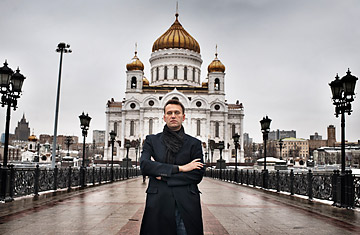
Alexei Navalyn in front of the Cathedral of Christ the Redeemer in Moscow.
(4 of 4)
But the incident fueled fears that he is a right-wing fanatic, and after the December demonstrations, slick cartoons started circulating online depicting Navalny throwing the Nazi salute and wearing a T-shirt that reads I'M A FASCIST. Navalny laughs this off as ignorant fearmongering. "People aren't really afraid of my views," he says. "They are just afraid of the word nationalism," which they associate with some "abstract nationalist menace." But his oratory style has not done much to change this. During both of the protests he addressed last month, his speeches dissolved into frenzied screaming, which spawned comparisons to Hitler. "We don't want to wait!" he shouted. "We don't need any parties! This is our party! What other parties do you need?" A couple of weeks later, he seemed to regret the vitriol. "I know some people got scared," he told TIME in his meager office, where he runs a small legal firm. "I got too emotional, but what can I say? I really hate the people in power. I hate them with every fiber of my being. That is what drives me in almost everything I do."
Navalny has said he will run for President only when he is sure of an honest vote. He concedes that Putin, with no viable competitors, will likely win a third term in March. But that will simply continue to discredit Putin, he says, adding, "This will not be a legal presidency."
Though his political instincts are keen, Navalny is just emerging from the firebrand politics of the blogosphere, and he often sounds more like a hothead than a statesman. But his hatred for Putin's system is shared by a large and growing segment of the Russian electorate. No one can say whether that energy will be channeled into a revolution, into real democratic reform, or whether it will simply dissolve into feuding camps. But one thing is clear: Navalny has brought the anger out of the Web and onto the streets. There is no easy way to force it back.