

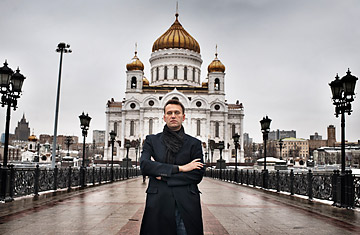
Alexei Navalyn in front of the Cathedral of Christ the Redeemer in Moscow.
(2 of 4)
If this was an attempt to silence him, it backfired. Navalny became a cause clbre. Supporters held vigils outside the jailhouse and sent him care packages, including 15 lb. of chocolate. Within a week, the protests spread to more than 70 Russian cities, and on Dec. 10 the opposition pulled off another record-breaking rally, with more than 50,000 people gathering in Moscow. Putin was derisive. During a live call-in show on Dec. 15, he said the symbol of the protest movement--a white ribbon--looked like a "dangling condom" and likened the protesters to Bandar-logs, the unruly monkeys from Rudyard Kipling's The Jungle Book.
After Navalny was released and took over the protest-organizing committee, the opposition staged the biggest demonstration since the fall of the Soviet Union. More than 100,000 people gathered on Moscow's Sakharov Avenue to call for democratic reform. Every stratum of Russian society was represented, most of all the young, educated middle class. The sight of a sea of protesters that day waving hand-drawn signs and chanting "Russia without Putin!" made it hard not to wonder, Where had they been all this time?
Since at least 2004, when Putin began his second term as President, there has been no secret about the patronage system he has built. Gubernatorial elections were canceled that year to allow the Kremlin to handpick regional leaders. Election laws were changed to make way for what amounted to a one-party state. Political competition became extinct, and no one was all that surprised when Putin announced in September that he would return to the presidency in March for at least another six years and possibly another 12. So why only after the disputed vote held on Dec. 4 have Russia's citizens ceased to be a silent, apathetic mass?
Navalny calls it the "76--82 effect," referring to the Russians who, like him, were born sometime from 1976 to 1982. "This is the Moscow baby boom," he says, "and they have come of age." During the Cold War, they were too young to soak up the Soviet culture of absolutism. "They understand that our existence is not defined as a conflict between East and West," Navalny says. They are old enough to have traveled around and formed mature political opinions but young enough, he says, "to feel at home on the Internet." That is where Navalny has worked under the radar of mainstream Russian politics. Senior officials have tended to dismiss him as a chat-room gadfly. They clearly underestimated his ability to sting.
As of November, about 70 million Russians--half the population--had Internet access; 55 million of them were actively surfing the Web, often to look for news and analyses free of the propaganda shown on state-controlled TV. Russia's favored blogging site, LiveJournal, has emerged as the only truly free and democratic medium for political discourse in the country, with about 30 million readers a month. Through his online campaigns against corruption, Navalny became an Internet folk hero.