

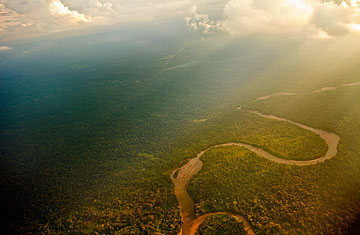
Heart of the forest Ecuador's Napo River feeds into the Amazon in oil-rich Yasuni National Park
(3 of 3)
If Yasuni is what it is largely because people are absent — with the exception of a few indigenous tribes that live deep within the forest — the amount of industrialization and human activity required to pump 846 million barrels of oil out of the ground would change the park irrevocably. "God gave us the gift of this rich place," says Jiovanny Rivadeneira, general manager of the Napo Wildlife Center, an eco-lodge on the edge of Yasuni. "If there's any oil exploration, we'll feel it first."
If the Yasuni-ITT Initiative moves forward, all that might be prevented. The plan would require Ecuador to refrain from extracting the oil contained in Yasuni indefinitely in exchange for at least $3.6 billion — half the value of the crude as of 2010 — which would go into a capital fund to be administered chiefly by the U.N. Development Programme. That money would be earmarked for investment in renewable-energy projects in Ecuador and social development for indigenous communities in and around Yasuni. As a guarantee, should a future Ecuadorian government decide to go ahead and drill for oil despite the deal, donors would essentially get their money back. "This is the only complete initiative that is out there that is a concrete proposal on how to govern global public goods," says María Fernanda Espinosa, Ecuador's Minister of Coordination of Heritage. "The international trust fund is the mechanism for it."
Although Ecuador has so far managed to gather $53 million in commitments from a number of countries and even some individuals, the international community seems unconvinced for the most part. Norway — which has used its oil money to fund anti-deforestation programs in Brazil and Indonesia — has so far passed on the plan. Hopes were high that Germany would come through with a major contribution, but so far there's little indication that an increasingly donation-fatigued Berlin is interested. The U.S. failure to pass cap-and-trade legislation largely dashed hopes that American money would play a major role in the Yasuni initiative. At this point, the plan seems to be on life support: Correa has given the world until the end of the year to come up with at least $100 million as a show of good faith, lest the project likely be scrapped. "We're renouncing an immense sum of money," Correa said in September. "For us, the most financially lucrative option is to extract the gasoline."
Beyond the fact that the ongoing financial crisis has tapped out creditor nations like Germany, there are reasons for the international community to be leery of the Yasuni initiative. The proposal doesn't fit into standard greenhouse-gas emissions-reduction schemes through the U.N. climate system, which means that donors wouldn't get carbon credits under the Kyoto Protocol. There's the worry of leakage as well. If Ecuador reduces oil production by preserving Yasuni, another producer in South America or the Middle East might pump more oil to make up for the shortfall, eroding the climate benefits.
And then there's Ecuador itself. The country had seven Presidents and two constitutions from 1996 to 2006, and in '08, Correa declared Ecuador's national debt illegitimate. Last year, Correa was nearly ejected from power in a violent coup, and he has fired many of the ministers who first championed the Yasuni project and has cracked down on the media and the opposition. None of this makes Ecuador seem like an ideal partner for a complex deal like the Yasuni initiative. "We haven't been the most stable country politically," says Natalia Greene, program coordinator for the Pachamama Foundation, an NGO that focuses on indigenous communities. "We need to send the world a message of trust for this to work."
In reality, the chance of success seems to lessen by the day, but the issues raised by the Yasuni project won't go away. South America is becoming an increasingly important oil producer — the continent holds 20% of the world's proven oil reserves — and much of that crude is buried in and around the Amazon basin. That puts the rain forest in mortal peril: as the global need for oil grows, we're like drug addicts willing to pawn our valuables to pay for the next fix. Yet the financial burden of protecting our most biodiverse forests — nearly all found in developing nations — can't fall only on poor nations like Ecuador. Each of us benefits from the existence of forest reserves like Yasuni, and each of us should share in the cost of preserving them. If we can't protect the rain forest in Yasuni from the drive for oil, we may not be able to protect it anywhere else.