

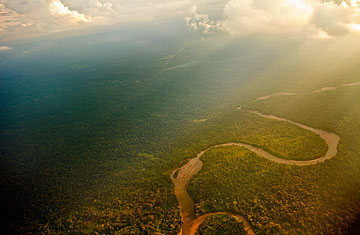
Heart of the forest Ecuador's Napo River feeds into the Amazon in oil-rich Yasuni National Park
(2 of 3)
In part because it is still relatively uninhabited and undeveloped — canoes are the only way in and out — it's rare to spend more than a few minutes on the creeks that crisscross Yasuni before you catch sight of a fat dragonfly, a rainbow boa or a golden lion tamarin. This is the Amazon untouched. But the rain forest really comes to life at night, when fruit bats glide through the air and insects and amphibians erupt in sound. Not everything is friendly, though: as our flashlights sweep the surface of the lake, the beams catch the single red eye of a black caiman. The crocodilian reptile — the largest predator of the Amazon basin — is easily over 3 m long, and its lingering presence explains why I was advised not to swim in the lake after dark. And there's almost certainly far more out there than I can see. "When you go to Yasuni, you will always find new species," says David Romo, an Ecuadorian biologist who has done field work in the park. "It would take us 400 years just to name all the insect species out there."
Indeed, even by the standards of the tropical rain forest — by far the richest belt of life on the globe — Yasuni stands out. There are estimated to be 100,000 insects per hectare, the highest concentration on earth. More woody tree species — 655 by one count — grow in a single hectare of rain forest in Yasuni than in all of North America. The park is home to 28 threatened or near threatened vertebrate species — including the white-bellied spider monkey and the giant river otter, which can grow to nearly 2 m — and 95 threatened or near threatened plant species. It is a bird watcher's paradise, with nearly 600 species, including white-throated toucans, the phoenixlike hoatzin and vast swarms of parrots. I've been to rain forests in Southeast Asia and Africa and Central America, but I've never seen the sheer amount of life that I glimpsed in a few days in Yasuni.
What's even more amazing is how much of that life is stuffed into such a small land area. Yasuni harbors nearly one-third of the Amazon basin's amphibian and reptile species, despite covering less than 0.15% of its total area. That's due in part to its unique location at the intersection of the Andes, the Amazon and the equator, which fosters high rainfall and a steady climate: the perfect formula to help life flourish.
That location also made Yasuni a jungle refuge during the recurring ice ages of the Pleistocene era 2.6 million to 12,000 years ago, a place where tropical species could escape the effects of glaciation. Scientists believe that geography could also help Yasuni better weather the coming effects of climate change, remaining wet and hospitable even as warming threatens to dry out much of the rest of the Amazon basin. "The world created a piggy bank of life in Yasuni," says Romo. "The park represents a chance for saving biodiversity in the future — and we have to protect it."
While Yasuni endured the ice age, it may not survive the oil age. Conservationists fear the effect of oil drilling in and around Yasuni because they've seen the damage that energy exploration can do to nature, and no one knows that better than Ecuadorians. The oil giant Texaco has been accused of polluting vast stretches of the Ecuadorian Amazon during its operations there in the 1970s and '80s, and the company, now owned by Chevron, is involved in a long-running $27 billion lawsuit over the damages — the world's biggest environmental case ever.
But it doesn't take spills and corporate negligence for drilling to disrupt an intact forest. Exploration requires pipelines, camps and roads, which would cut through the park and lead to direct deforestation. And those roads would bring colonization, which would lead to secondary deforestation, fragmentation of habitats and intensified hunting and fishing. A 2006 study showed that the Via Maxus, a road on the northeastern border of Yasuni, had 40% lower mammal abundance compared with an intact area in the forest interior.