

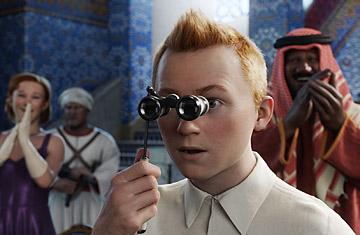
Tintin in a scene from The Adventures of Tintin: The Secret of the Unicorn.
(2 of 2)
The challenge was to turn Herg's famous ligne claire style into a 3-D world. "The books became the bible for all the set decorators and production designers at Weta," Spielberg says. The biggest challenge was Tintin himself, whose face on paper is as simple and elegant as a punctuation mark. "We probably spent two or three years working at every subtlety and nuance of Tintin's face," Jackson says. "Steven and I would have long videoconferences with the design team where we would look at CGI heads rotating on turntables and say, 'Could his eyes be 15% smaller? Could his eyebrows be a little bit lower?'"
For Spielberg, directing an all-digital movie came with a learning curve. "I'm used to coming on a set and being inspired by the actual quality of the sky that day, the way the light is hitting the trees and the buildings," he says. But there was no set for Tintin. "It was just like a big basketball court, a big, white, clinically, surgically antiseptic space." Spielberg worked with a digital model of the space, which he watched on a screen as he shot the actors.
The result is a brightly colored, relentlessly paced adventure with the same pulpy, retro, swashbuckling quality as an Indiana Jones movie. The action sequences, liberated from the laws of physics and movie budgets, must be among the most elaborate ever devised. At one point, Tintin, his dog Snowy and the perpetually drunk mariner sidekick Captain Haddock chase a falcon through a Moroccan hill town through which a rampaging flood is roaring, picking up and destroying vehicles as they go. Herg's love of physical comedy is all there: he borrowed liberally from movies, especially Charlie Chaplin's, and Spielberg collects on the debt, transplanting the gags back into their original medium.
The movie is densely packed with little Tintinacious touches for serious fans. Captain Haddock, played by Andy Serkis (the performance-capture veteran who also portrayed Gollum in Jackson's Lord of the Rings trilogy), looks particularly authentic: they've nailed the wet black thatch of hair and the tiny gin-blue eyes. Spielberg imported the Siamese cat from The Seven Crystal Balls, and there are at least two crabs with golden claws. He pulls off a brilliant gag wherein a swimming Tintin's red quiff substitutes for a shark's sinister dorsal fin--a nod to Spielberg's Jaws.
All this high-powered technology serves a movie set in an indeterminate but decidedly retro past, a dreamy world of vintage cars and rotary phones. It turns out that it takes the computing resources of a cutting-edge data center to bring to 3-D life what Herg created using only pen and paper. "That's probably the thing that impressed me the most about the books," Spielberg says, "that Herg was a filmmaker in his own right."