

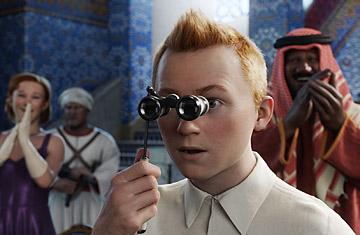
Tintin in a scene from The Adventures of Tintin: The Secret of the Unicorn.
DEC. 21
In the beginning was the word, and the word was Tintin. Steven Spielberg didn't know what it meant. "Raiders of the Lost Ark had just opened overseas," he says, "and all through the French reviews, which I couldn't read, there was a smattering of Tintin everywhere."
Tintin is, of course, the first and only name of the indefatigable, incurably innocent boy reporter who has sold upwards of 200 million books worldwide since he first appeared in a comic strip in 1929--though he has somehow managed to do it without making himself a household name in the U.S. Once all this was explained to him, Spielberg hunted down his very first Tintin book, which happened to be The Seven Crystal Balls. "It was like a movie, with beautifully rendered storyboards," he says. "I understood the story. I understood the humor. I just got it without having to hear the words."
In 1983 Spielberg called Herg, Tintin's creator, who was 75, to talk about making a Tintin movie. Spielberg planned to visit Herg in Brussels a few weeks later, but Herg died before that could happen, and the project stalled. It would be nearly three decades until Spielberg brought Tintin to theaters.
It's either touching or ironic, or a bit of both, that Tintin is making his big-budget, big-screen debut in The Adventures of Tintin at a moment when grave economic woes threaten the great pan-European dream. He is the pan-European hero par excellence--he was pan-European before there was a pan-Europe--and far from fading away, he's about to take a shot at going global, with the help of an American and a New Zealander.
Tintin didn't start out pan-European, let alone global. He started out Belgian. Herg was the pen name of Georges Remi, born in 1907, the son of a candy-factory worker in Brussels. But today Tintin's story has been translated into 60 languages. (He is Dingding in Chinese and Tincjo in Esperanto.) It's not hard to see why: the Tintin books are some of the most satisfying popular entertainment ever created. Tintin is the eternally dogged underdog--undersized, underestimated and always outgunned, but undaunted. "Tintin can't be dissuaded from his quests," Spielberg says. "He's relentless in his pursuit of the solution to these exotic mysteries." Like Lewis Carroll's Alice, Tintin is the one sane mind among schemers, dipsomaniacs, eccentric geniuses and blithering idiots. Herg drew his panels in an instantly recognizable style known as ligne claire, or clear line. Each frame is a window into a bright, simple, comprehensible universe, both foreground and background in perfect focus, with a bare minimum of shadows.
It wasn't until 2003 that Spielberg went back to the project. "I suddenly had a brainstorm, and I figured out how to do this," he says. "I also figured out what medium I wanted"--that medium was motion-capture animation, or as Spielberg calls it, performance capture. He used the same animators who worked with James Cameron on Avatar: Weta Digital, based in New Zealand and co-founded by director Peter Jackson. The project evolved into a full-blown collaboration. "You can't grow up in New Zealand without having Tintin become an important part of your life," Jackson says.