

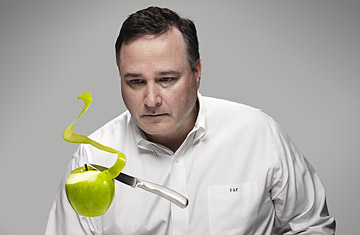
Inventor Peter Freer uses EEG technology to improve attention dramatically
(3 of 3)
Freer saw an opportunity: What if a simple consumer device could show ordinary people when their concentration was drifting? It was a very cool, very naive idea. It was cool because Freer, as a science teacher, understood that you don't need cables attached to the scalp to measure neurotransmission. Because skin is a fantastic conductor of electricity, sensors anywhere on the body would be able to detect changes in the brain's electrical pulses. Freer's idea was naive because--again, as a science teacher--he had no money to build a consumer-level EEG sensor. So he took another job, as a martial-arts instructor, and then a third job as a security guard at a restaurant. Freer says he put $300,000 on credit cards before finally seeing the first BodyWave prototype five years ago.
It wasn't long before EEG experts began to notice Freer's technology. Rob Templeton was one of the first. He helps run the training program at OPG. Like any nuclear plant, it requires not only years of training for employees but also constant retraining. No matter their age, operators who work in the main control room must spend one week out of every six in retraining exercises. A few years ago, Templeton was reading a trade publication when he ran across a story about a company--Freer's--developing portable hardware that could address attention deficits. He cold-called the company.
Giddy and nervous, Freer then developed specific software for OPG. Operators strap on the BodyWave and then see, onscreen, a series of 20 valves. Instructions appear in the top left corner. For instance:
1. Operate hand switch 2QFX96 from OFF to ON. 2. Place selector switch 4P1BEU26 to OFF.
Technicians can execute these commands only by focusing to the point that beta waves start to flow. Once the BodyWave registers peak betas, it instructs the computer to perform the tasks.
The BodyWave is discomfiting to many users because it can detect changes in your thoughts before you do. What if the computer gets it wrong? Trainers at OPG, NASA and NASCAR told me they use the device not to judge performance but rather to improve it. Still, there's a fine line between training and evaluation. If you can't train well with the BodyWave strapped to your arm, doesn't that mean you can't control your thoughts? Shouldn't you then lose your job?
Freer says he doesn't want the BodyWave used as a punishment but as a tool. He and his small team are now developing software for golfers. A player wearing the BodyWave would wait to see a light indicating full concentration before making a putt. Whether the resulting putt would be considered cheating or attaining perfect focus is an open question.