

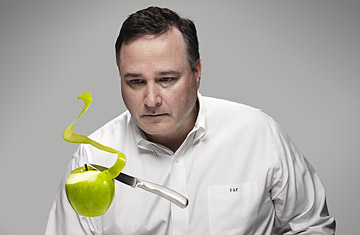
Inventor Peter Freer uses EEG technology to improve attention dramatically
(2 of 3)
True, most people can easily discern when they have been daydreaming. But the evolutionary process hasn't sharpened that discernment enough to prevent stupid accidents--drifting into the other lane, say, or slicing into a finger instead of the carrot on the cutting board. The promise of EEG technology is that it can alert you to inattention before you are aware of it. Right now, the BodyWave is the only EEG device on the market that simply attaches to the skin and requires no wires to be inserted or attached to the head. But it has a serious flaw: it can transmit your data only to a computer screen. If NASA trainers are looking at the screen, they can see that you have lost focus before you know it. But the device itself has no light or sound that can tell a casual user to stop before they do something stupid.
The creator of the device is working to fix this problem. He isn't a Jobs or a Zuckerberg, but rather a former schoolteacher named Peter Freer. Freer, who is 52 and lives outside Asheville, N.C., is a tinkerer, but one possessed of expansive sensibilities. As a child in Millbrook, N.Y., in the 1960s, he would occasionally visit a neighbor's house to play with the kids. The house was populated with strange characters, and its owner turned out to be Timothy Leary.
Freer acquired one of those temperaments that are open to experimentation but are also somewhat aimless. After he eventually got a job teaching science in North Carolina schools, he noticed that many of his students diagnosed with attention-deficit/hyperactivity disorder had little trouble paying attention. "I would see a student daydreaming," Freer recalls. "After class, I would ask him, 'What can you tell me about my class?' He could tell me about a bird he saw outside--its color and where it was on a tree. He could tell me that the AC kept turning on and off at regular intervals. He could remember what the boy next to him was wearing. And he knew a little about the lesson. This kid had paid plenty of attention. It was sustaining and willfully directing attention that was an issue for him."
Freer had taken computer courses at Western Carolina University, and he thought there might be a way to devise software that could measure attention in real time. He discovered that NASA had been using EEG for years to illustrate to pilots that concentration has two murderous enemies: hypoarousal (letting your mind drift) and hyperarousal (trying so hard to focus that the effort itself becomes distracting). Throughout the 1980s and '90s, NASA and other big institutions explored EEG technology using huge, helmet-like apparatuses that surrounded the head with scores of cables.