

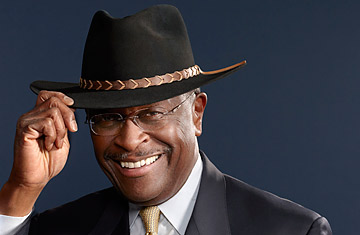
Herman Cain
(2 of 4)
Plus, in a campaign that can seem like reality television, the Hermanator, as he likes to call himself, simply puts on a great show. He is America's unlikeliest new star, hitting The Tonight Show and The View, being mocked on Saturday Night Live and beaming from the cover of his new memoir, This Is Herman Cain! My Journey to the White House. And how many other presidential contenders like to sport black hats and sunglasses or have released their own gospel album? "We have a severe deficiency of leadership," Cain says. The question is whether he's really the kind of leader Republicans are looking for--or just the latest vessel for their intense anti-Establishment frustration.
Unlikely Hero
When Cain visited TIME's New York City offices for an interview in early October, he was certainly a man in action. He arrived with campaign staffers and a book publicist, fresh from a meeting with Donald Trump. ("We hit it off right away," Cain said.) His schedule was packed: Cain paused his interview to dial in to Sean Hannity's radio show, a conservative publication was waiting for its own interview, and his press aide had to turn down yet another request. Afterward, he was off to meet a group of wealthy Manhattan donors. And that cowboy hat he posed in for Time? We supplied one because black hats are a Cain signature. Cain liked it so much, he took it with him; an aide asked our photo editor to send a bill.
It's an unpredictable place to find a man who grew up poor in the segregated South. Cain was born in Memphis and raised in Atlanta, where he lives today. His father was a driver for Coca-Cola's top executive, as well as a janitor and barber, and his mother was a cleaning lady. A graduate of Atlanta's Morehouse College who completed his master's at Purdue University, Cain studied missile trajectories as a civilian employee of the U.S. Navy before joining the Pillsbury Co. There he turned around a group of some 400 struggling Burger Kings, and in 1986 he took over the company's foundering Godfather's Pizza chain. Godfather's "lacked focus," Cain says, so he condensed the menu and simplified its marketing. He went on to arrange a leveraged buyout of the company, stayed on as CEO and made millions on its turnaround before stepping down as chief executive in 1996. His story, Cain says, proves that anyone can succeed in America. Creating jobs, he adds, isn't so different from delivering pepperoni pies. "This President does not understand a fundamental economic principle, which is that the business sector is the engine of economic growth."
Not that Cain, who survived a severe 2006 bout with colon cancer, is a total newcomer to politics. Republicans first took notice of him in 1994, when Cain forcefully challenged Bill Clinton about the costs of his health care plan during a televised town-hall meeting. (The exchange is now a YouTube hit.) Former GOP Congressman Jack Kemp made him an adviser to the 1996 Dole-Kemp ticket, and Cain tested his own White House bid in 2000. He also mounted a losing U.S. Senate campaign in Georgia four years later. While living in Omaha in the 1990s--Godfather's is based there--he chaired the Kansas City, Mo., arm of the Federal Reserve. And he spent nearly three years in the late '90s running the Washington-based National Restaurant Association, in effect serving as the dining industry's top lobbyist.