

(3 of 3)
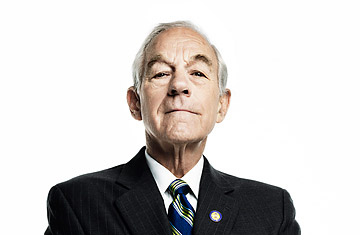
Paul isn't a pure libertarian. He doesn't support abortion or gay marriage; he believes those issues should be left up to states. But he has a coherent worldview: that individual liberty is the highest American ideal and a free-market economy its foundation. Paper money is a mirage predicated on trust in a government that can't be trusted. Fealty to the Constitution means accepting the parts of it you might not like, whether it's your neighbor's right to shoot heroin or gamble away his paycheck. "You can take your life and be very productive, or you can be destructive," Paul says, "but you can't meddle in other people's lives."
Paul's acolytes often speak of him in nearly messianic tones. "It's like a light switch going on. You see things you haven't seen before," says Doug Wead, a senior adviser who served under both George W. Bush and Bush's father. After Paul spoke in Concord, hundreds of fans thronged to greet him. Kate Baker, the national chair of a group called Women for Ron Paul, tried to organize a greeting line. "Ron Paul walks where he wants to walk and stops," she tells an eager fan. "We follow him."
A Revolution Matures
For a political prophet, paul isn't much of a speaker. He tangles his syntax and is prone to rambling. But one man's awkward is another's authentic, and when you are trying to sell a candidate as a truth teller, it's best if the packaging doesn't show: his newest ad contrasts him with the "smooth-talking politicians" he's running against. "We've run into Romney. We ran into McCain. Whenever you talk to them, you feel like everything they say is almost programmed," says Jesse Coffey, a 17-year-old Paul volunteer who is among the candidate's many young devotees. "When you meet Ron Paul, it's like meeting an old friend you haven't seen in years."
For the next hour, Paul stands in the gathering dusk, shaking hands, snapping pictures and signing memorabilia: $2 bills, a watercolor portrait of his face, a copy of the John Birch Society's magazine. "I'd ask you to sign my chest, but it probably wouldn't be appropriate," says one woman, who settles for her sleeve. A trio of young men, including one in a T-shirt depicting a vampiric George W. Bush sinking his fangs into Lady Liberty, crowd around the Congressman to vent about the treatment of Bradley Manning, the Army private imprisoned for allegedly slipping a trove of classified documents to WikiLeaks. "They tried to throw Daniel Ellsberg in jail too," Paul says, shaking his head, recalling the furor over the Pentagon Papers 40 years ago.
The 2008 Paul campaign was a ragtag coalition of anarchists, antiwar activists, goldbugs, paleoconservatives, hard-core libertarians and conspiracy theorists. His grassroots supporters threw raucous rallies, floated a Ron Paul blimp, lionized the 17th century British revolutionary Guy Fawkes — infamous for his attempt to blow up Parliament — and raised huge chunks of cash through online "money bombs." But his organization was hapless when it came to translating that enthusiasm into votes. "Last time, we didn't know what we were doing," says Chris Lawless, 42, a volunteer who voted for Paul back in 1988 when he ran for President on the Libertarian Party ticket. "We made WHO IS RON PAUL? T-shirts" — a reference to the "Who is John Galt?" refrain in Ayn Rand's libertarian touchstone Atlas Shrugged. "We had a freaking blimp."
Paul was almost a passive figurehead in that spectacle, putting his message ahead of campaign tactics. "His goal, I think, was to use his platform as a pulpit to keep talking about these things until people understood it," says Jim Forsythe, his New Hampshire campaign chairman. "Enough people understand it now. It's time to do something about it."
Convinced that he has a shot in 2012 — a late-August Gallup poll showed him running nearly even with President Obama in a hypothetical matchup — Paul's aides have hired seasoned operatives and are more focused on ballot-box results, demonstrating early success at the Iowa straw poll. And Paul is still raising big money, including a $1.8 million money bomb to mark his Aug. 20 birthday.
There remains the matter of the candidate himself, though. "He's incorruptible," Wead says. "He just will not say or do anything that is not based on what he believes, even if it will help his cause. It's very frustrating, because at times using different language would be so much more politically effective."
Whether or not Paul attracts more votes than he did in 2008, his ideas have clearly taken on a life of their own. And that's what Paul says is most important. "I do what I do because I believe that truth wins out in the end," he explains. Even if his candidacy will have a hard time doing the same.