

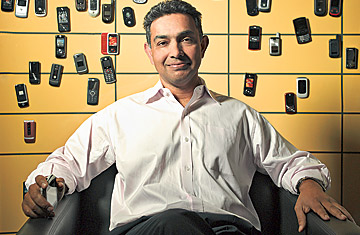
Motorola's co-CEO Sanjay Jha
(2 of 2)
Enter Jha, a former Qualcomm executive who had become a rock star in industry circles. Hired in 2008, Jha was enticed to Motorola with $100 million in performance-contingent bonuses and stock options, making him one of the highest paid U.S. executives that year. "Motorola's [board] had to decide — shut down the business, or find one of the very few people both capable and willing to turn things around," says Avian Securities analyst Matt Thornton. "Someone of Sanjay's caliber had to have incentives to take this on."
That investment is showing some positive signs. Handset sales began slowly improving in late 2009 as Jha set about changing Motorola's 9-to-5 corporate culture and wooed top talent away from competitors. He scrapped much of the 2009 product portfolio in favor of new smart-phone offerings, all running Google's Android operating platform.
Hitching Motorola to one horse — even if it's Google — was a risky but necessary move, as the market-leading iPhone taught consumers to increasingly demand usability in addition to cool hardware, Motorola's traditional specialty. "Software is the star now," says Carolina Milanesi, a Gartner analyst. "The choice of Android was one Motorola couldn't postpone without risking falling further behind or never recovering at all."
By the end of last year, Motorola emerged as one of the largest shippers of smart phones. That's largely due to Droid, its newest offering for Verizon Wireless. Motorola has also made headway with Cliq, its T-Mobile phone, and early in March it launched BackFlip, the first Android phone for AT&T. About 40% of wireless customers now use smart phones, according to Web research firm Crowd Science, and that portion is growing rapidly. To complement Android, Motorola developed Motoblur, one of the first user interfaces to unite social-networking tools such as Facebook, Twitter and MySpace. "We fundamentally changed our focus from market share to profitability with this new emphasis on smart phones," Jha says. "But that's what our research showed consumers want."
None of these products have proved to be an iPhone killer. That could be problematic for Motorola in the long run, especially if Apple breaks its exclusive contract with AT&T. The Crowd Science survey found that iPhone users account for 1 in 3 smart-phone owners. Among non-iPhone users, nearly 40% say they would switch to an iPhone for their next purchase. "Much of Droid's success has resulted from Verizon pushing it as its lead product," says Jefferies & Co. analyst William Choi. "What happens when Verizon can sell the iPhone?"
Motorola's focus on smart phones may limit its overseas growth. The high price tags of smart phones drive profit but not necessarily volume, particularly in emerging markets. And as part of its cost cutting, the firm is all but gone from most of Africa and the Middle East.
Strong brand recognition, though, will help Motorola recapture market share in Latin America, China and the U.S. Indeed, being a household name is one of the best competitive advantages Motorola retains, making its recent decision to manufacture phones branded with Google's name another questionable one. Already Motorola has had to pull Google from its phones being shipped to China after the search-engine company butted heads with the government in March. "That's O.K. for a less familiar brand like [Taiwan's] HTC," Gartner analyst Milanesi says. "But there is no value to Motorola in making phones for others. It needs to concentrate on re-establishing its own brand."
Long term, Jha will need to consider Motorola's building its own operating software. For now, though, the first goal will be to restore stability to the beleaguered unit, especially as an independent company. One of the first steps will be to explore synergies with the TV-set-top business. "Right now, about 80% of the content people use comes to them in their home," Jha says. "But they increasingly need to carry that content on their cell phones. How can we make that easier?"
Meanwhile, Brown's new spin-off will absorb Motorola's $3 billion in debt. But the split also means his charge will be able to keep the strong cash flow. "We will reinvest some of that money in expanded innovation, and we can consider ways to grow the firm organically or potentially through acquisitions," Brown says. "It will also be easier to attract world-class talent to a world-class firm rather than one in transition." Perhaps two heads will prove, after all, to be better than one.