

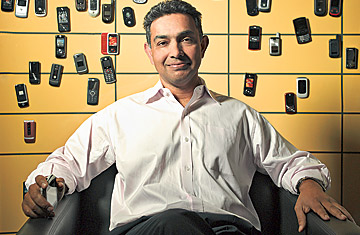
Motorola's co-CEO Sanjay Jha
Greg Brown, Co-CEO of Motorola, likes to compare his company's recent performance to the Dickens classic A Tale of Two Cities. Yes, that's got to be the most clichéd literary reference in Western history, but Brown is not a wordsmith. He runs a gadget company. And that's the problem: Motorola was once renowned for manufacturing ultra-chic mobile phones. Yet since 2006, that business has been in free fall, and the company's overall revenue has dropped by half. The recession didn't help much. Keeping the $22 billion firm afloat were its less glamorous but profitable units that sell two-way police radios, barcode scanners and networking equipment for telecom carriers.
Brown says 2008 "marked the best year ever for our home and enterprise-mobility segments and the worst year ever for our mobile-device business. There were really two stories behind one Motorola."
Motorola's dire straits required a dramatic reinvention. So over the course of 2008, it slashed costs, replaced nearly 70% of its senior executives, transformed its corporate culture and hired Sanjay Jha, Brown's co-CEO, to resurrect its handset segment. Then it took the turnaround one step further, announcing plans in February to split the corporation into two independent entities.
By the first quarter of 2011, Motorola's assets will be divided evenly, with both parts sharing intellectual property and the brand name. Jha will oversee the mobile-device and television-set-top-box businesses. Brown will run the rest, which the company calls Motorola Enterprise Mobility Solutions and Networks, a name that could only have been fashioned by engineers. "I've long advocated that these were two distinctly separate companies," Brown says. "The split will mean renewed focus, improved innovation, better customer satisfaction and increased employee engagement."
Conglomerates have fallen out of favor in corporate America, and Motorola is the latest to be torn apart. As a separate entity, a company comprising the radio and networks units — both mature, stable businesses — could become a classic widow-and-orphan value stock that investors love, generating high dividends. Mobile, however, will be the growth opportunity.
After two difficult years — in 2009, the mobile market declined for the first time since 2001 — the handset industry appears to be on its feet again, according to research firm Gartner Technology, with sales stabilizing at 340 million units sold in last year's fourth quarter. Some analysts expect the worldwide mobile-subscriber base to almost double by 2013.
As Motorola knows all too well, it will take a red-hot hit to capture those new customers. The 81-year-old American institution, based in Schaumburg, Ill., has a celebrated history: its engineers invented the cell phone and, before that, the walkie-talkie, as well as one of the world's first semiconductors. By the early 2000s, it had also produced the best-selling mobile phone of all time, the StarTAC, the world's first clamshell. It surpassed that feat with the ultra-sleek Razr, introduced in 2004. The Razr transformed the mobile market, and more than 100 million units were sold in its four-year run. It was the iPhone of its time.
Today the iPhone is the iPhone of its time, a sleek machine with the ability to handle the Web, e-mail and photos and run a jillion apps — features that Motorola mostly failed to develop in following up on Razr's achievements. "Razr's success hid some fundamental shortcomings in how the business was being run," Jha says. Meanwhile, he adds, "the Chinese and Koreans were coming in and innovating faster than we were."
The cost of that failure? By 2008, market value had fallen by more than $37 billion in less than 18 months, and in 2009, Motorola's market share was halved from the prior year. Motorola fell from the No. 2 mobile manufacturer globally to barely eking out a spot in the top five, leading some to suggest that the handset unit should close shop. Investors, including billionaire activist shareholder Carl Icahn, began agitating for Motorola's breakup.