

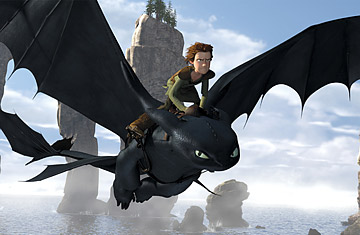
A scene from How to Train Your Dragon
(2 of 2)
The studios also favor different kinds of stories. Pixar makes movies about couples — guy-guy in Toy Story, Monsters Inc., Cars, Ratatouille and Up, and guy-gal in Finding Nemo and WALL•E — who overcome initial antagonism and find a shared need. To wit, buddy stories and love stories. DreamWorks does workplace comedies about groups, in Shark Tale, Over the Hedge, Kung Fu Panda, Monsters vs Aliens, both Madagascar movies and the later Shreks.
The two studios' preferred plots reflect their means of creation. Pixar writer-directors, working in a San Francisco suburb far from the seat of industry power, get lots of staff support but pursue their visions more or less on their own. DreamWorks movies, made mostly in the Hollywood suburb of Glendale, are team efforts. A Pixar film may have one writer besides the director; it's total auteur handicraft. Most DreamWorks movies credit two directors and several writers, and play like the spiffiest vaudeville. The DreamWorkers aren't in the masterpiece business; they just want to provide an expert good time.
All Aboard the Dragon Train
Fun is the first of the goals set by Chris Sanders and Dean DeBlois, Dragon's directors and (with Will Davies) writers, for their version of the Cressida Cowell book. Their teen hero, Hiccup (voiced by Jay Baruchel from She's Out of My League), is the underachieving son of a fierce Viking warlord, Stoick (300's very own Gerard Butler), whose tribe has been battling dragons for centuries. When Hiccup wounds an elusive creature called the Night Fury, no one believes him. Soon he tames, trains and learns to ride the beast, thus schooling his clan in the proto-eco message that the wilder forces of nature should not be fought but instead cultivated.
This is the rare DreamWorks movie that might have benefited from a few more gag writers. Its early reels rely too heavily on the conceit that medieval Norsemen spoke with a Scots accent, and the other teens in Hiccup's dragon-training class never surmount their stereotypes. But Sanders and DeBlois, two Disney vets who told a similar kid-and-feral-pet fable in 2002's Lilo & Stitch, have the knack of giving life to fantastical interspecies friendships. And the technicians at their disposal (including the Coen brothers' ace cinematographer, Roger Deakins) have splashed the screen with landscapes that would captivate all eyes even if the movie weren't in 3-D.
How to Train Your Dragon is a little more serious and more ambitious than the signature DreamWorks films — at least as much an action epic as a cartoon comedy. In its loftier moments, it might almost be called Pixarian. But the movie may simply be a detour for the studio, not the hint of a new direction. After all, in May comes Shrek Forever After, in which, we'd guess, the DreamWorks vaudevillians will cavort again.