

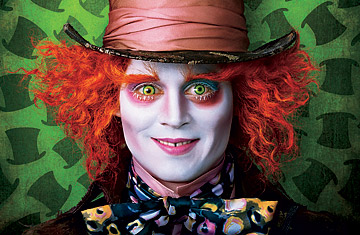
Johnny Depp as the Mad Hatter in Alice in Wonderland
(2 of 2)
Some actors lend their voices to CGI characters: Alan Rickman to the Caterpillar, Stephen Fry to the Cheshire Cat, the 92-year-old Gough (in his fifth Burton film) as the Dodo Bird. Other stars appear in fanciful makeup. Johnny Depp's Mad Hatter matches his flaming red hair with red eyeliner, as if he'd been crying for years; he's a gentleman ghoul out of Johnny Weir's closet. Anne Hathaway, as the White Queen, is given crimson lips, platinum hair and, alas, no redeeming quirks. Bonham Carter (Burton's partner offscreen) sports blue eye shadow that could have been applied by windshield wipers. Iracebeth is as much a spoiled child as an evil monarch, pouting as she demands a pig for a footstool, and Bonham Carter plays her as a parody of Bette Davis in her Queen Elizabeth roles. There's a lilt to her malevolence; she keeps fey at bay.
Wonderland's Joan of Arc
Screenwriter Linda Woolverton and Burton made two big changes to the text. One was to transform Carroll's episodic tale into an epic quest, based on the poem "Jabberwocky." Alice must seize the vorpal sword and slay the fearsome Jabberwock. In assuming this challenge, she becomes a female Frodo, Wonderland's Joan of Arc. This twist legitimizes the feature-length running time but also risks turning this jovially anarchic enterprise into your standard action-adventure. The film is better at reveling in eccentricity than at replaying Excalibur.
The other change was Alice's age. In the book she is "seven-and-a-half, exactly"; here she's 19 and meant to wed a pruny nobleman. It's not a crime for a film to turn a girl into a young lady: Judy Garland in The Wizard of Oz was 16, about twice the age of the book's Dorothy. And upping Alice's age removes the whisper of pedophilia that the 20th century applied to the love that Charles Dodgson, the Oxford math professor who was the real Lewis Carroll, lavished on the real Alice Liddell, the 10-year-old for whom he extemporized the original story on a canoe trip in 1862.
Wasikowska, the Australian who was superb as a suicidal teen on the HBO series In Treatment, brings a soft-focus regality to her role. Emotionally, though, her Alice is a bright child, a preteen in a late teen's body, as if she had suddenly sprouted by nibbling a magic cake. Her Wonderland dream is an escape from social strictures back to the freedom of childhood, and not imprisonment but liberation.
The movie Alice is also stricken by her beloved father's death — as Dodgson said he had been. So the movie is in a way an autobiography of each man-child responsible for it: Carroll and Burton. That may not matter to the kids who find this film much livelier than earlier versions and easier to warm to than the original. And is Burton's vision trippy enough to serve as a hallucinogenic blast? Go ask Alice.