

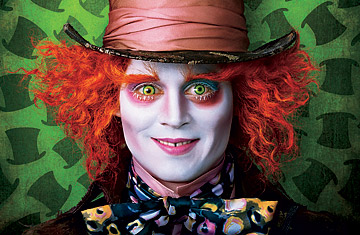
Johnny Depp as the Mad Hatter in Alice in Wonderland
Did many children truly love Lewis Carroll's Alice books? Did they embrace the absurdities and antique wordplay of Alice's Adventures in Wonderland and Through the Looking-Glass with the same rapt fervor they invested in other favorite stories, or did they find the Carroll works dry and remote? Couldn't it be that kids were listening out of politeness to the big person sitting by their bed? Martin Gardner, author of the 1960 The Annotated Alice, thought so. "It is only because adults — scientists and mathematicians in particular — continue to relish the Alice books," he wrote, "that they are assured of immortality." Make that scientists, mathematicians and '60s potheads, who saw Alice's descent into the rabbit hole, the EAT ME cake and the mushroom-borne caterpillar as evidence of the first great psychedelic trip.
Anyway, it's adults who've made the couple dozen film versions. The Carroll texts are appealing because their vaudeville format — Alice's encounters with a series of outlandish comic creatures — lends itself to brief star turns. W.C. Fields played Humpty Dumpty, Gary Cooper the White Knight and Cary Grant the Mock Turtle in Hollywood's 1933 Alice. Peter Sellers, John Gielgud, Michael Redgrave and Michael Gough helped populate Jonathan Miller's 1966 BBC TV play. Sellers joined other Brit luminaries in a 1972 film of the books.
These films, and the Disney version in 1951, had their incidental pleasures but also an arch, starchy tone to the parade of Carroll's lunatics. What the author needed all along was a kindred cinematic soul: a grownup with the reckless imagination of a child or a nonsense artist, a director who'd impart a wonder to Wonderland.
For example, Tim Burton. At 51, Burton still has the otherworldly air of a bright kid distracted from conversation with adults by the crazy-beautiful pictures playing in his mind. Since Pee-wee's Big Adventure, his 1985 debut feature, Burton's signature films have dwelled in the realm of arrested infancy. When he hasn't adapted children's classics (Sleepy Hollow, Charlie and the Chocolate Factory), he's confected his own scary, sweet bedtime fables (Edward Scissorhands, The Nightmare Before Christmas, Corpse Bride). The typical hero of these films is a naïf who stumbles into a world that threatens or baffles him and whose armor against its denizens is his innocence. Granted, that's the plot of many children's books, from The Wonderful Wizard of Oz to The Lord of the Rings. But it also suggests that Burton has been making variations on Carroll his whole career. His new Alice in Wonderland is just the official version.
It happens that the movie arrives in a little sulfur cloud of industry rancor. When Disney, its distributor, announced that the picture would be released on DVD only three months after its opening in movie houses instead of the usual four, the bosses of British theater chains balked, declaring they would not show Alice. A compromise was reached, and the film is now playing throughout the U.K.
That news should be of interest only to accountants. So how's the movie? Mostly frabjous. The visual palette is more artfully riotous than that of other Alice films, the performances more zestful. The walls of the hole that Alice (Mia Wasikowska) falls into are stocked with all manner of the White Rabbit's mementos; this could be WALL•E's cluttered annex. Alice meets flowers with faces and cruel tongues, frogs that serve as insecure butlers to Iracebeth the Red Queen (Helena Bonham Carter) and a more voluptuous picturization of Wonderland — here it's called Underland — than even Carroll could have dreamed. Though the 3-D goggles function almost like sunglasses, filtering out about 20% of the light, Dariusz Wolski's images are luminous and cunning enough to evoke the vivid colors of old Warner Bros. cartoons.