

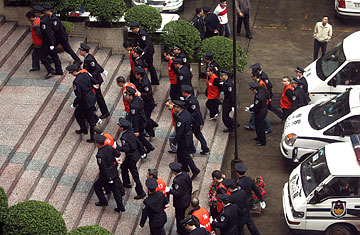
Crime wave
Police hustling a group of defendants into court during the height of the crackdown
There may be good places to die in China, but Edinburgh isn't one of them. This housing development on the outskirts of the city of Chongqing bears only passing resemblance to its Scottish namesake. Just over a decade old, the brick and gray stone façades already bear the dilapidated look of abandoned manors. Outside the gates is a broad expanse of demolished homes, populated by the homeless sleeping under tarps. A group of "stick-stick" men, who grind out meager livings hauling goods on bamboo poles balanced on their shoulders, sit playing cards. Smoke from a bonfire of garbage mixes with the miasma of smog in the sky.
At around 2 a.m. on June 3, 2009, Li Minghang — a 44-year-old man whom authorities say had a history of drug-dealing and loan-sharking — left his white BMW at the Edinburgh car park and headed for the front gate with his wife. An assassin lurked nearby. "He walked toward them and shot the husband as he passed by," says a 23-year-old security guard surnamed Huang who was on duty that night. "I heard two gunshots," he says. "The shooter was picked up by a car immediately afterward." Huang helped Li into a taxi; the injured man later died at a local hospital. "This place," admits Huang, "is not very safe."
Certainly not if you're a mobster. The brazen killing of Li, apparently a victim of gang warfare, spurred Chongqing's officials to speed up the launch of a citywide crackdown on organized crime. Since the middle of last year, police have arrested more than 1,000 people and to date have prosecuted 782, including 87 government officials allegedly in cahoots with the criminals. So far, four of those convicted have been executed. The campaign, which officially ended Feb. 28, has earned praise for Chongqing Communist Party Secretary Bo Xilai, onetime Commerce Minister and son of a former Politburo member. When the mafia trials were being held, crowds would gather outside the courthouses demanding that justice be served. One man whose son was killed by thugs in a clash over a fish farm in the city's exurbs even placed an ad in a local paper thanking the local government for its efforts. "In a lot of places, the government is still too corrupt, but [here], speaking overall, they are good," says the farmer, 56-year-old Yi Dade. "Without Bo Xilai or [police chief] Wang Lijun, there would be no hope for our family. The protective network of gangsters is very big."
Law and Disorder
Chongqing hasn't had this much attention since it was the temporary capital of China during World War II. Looming on the broad banks of the Yangtze River, it is sometimes called the biggest city in the world; half its population of 28 million lives in a huge swath of countryside that was carved out of neighboring Sichuan when the city was given provincial-level status in 1997. Like much of the rest of China, Chongqing is booming, but, along with the economy, crime has risen, especially extortion and racketeering. Locals say gangs take a big cut of everything from transport to construction. The recent crackdown has made Chongqing's criminal woes a national subject, but the reality is that its problems are commonplace. Take a stroll through practically any city in China and you can see examples of the protective network between organized crime and law enforcement. Prostitution and illegal gambling dens are ubiquitous, sometimes just a short distance away from police stations. "Everywhere you go it is pretty much the same," says Ko-lin Chin, a professor at Rutgers University, Newark, who is an expert on Chinese gangs.
But in its crackdown on crime — the biggest anyone can remember — Chongqing is unique. Driven by Bo, an ambitious outsider whose lack of local ties has given him a free hand to pursue his cleanup campaign, Chongqing's trials have riveted the country. Lurid details about once powerful mobsters and officials have spilled out in open court and across the pages of daily newspapers. In November, Xie Caiping, a mafia "godmother" who ran underground gambling houses and kept a harem of young men for her own pleasure, was sentenced to 18 years in prison. Her brother-in-law Wen Qiang, the former head of Chongqing's judicial bureau and deputy police chief, went on trial Feb. 2 — the highest official implicated. He faces charges of rape, selling promotions to police officers and accepting $2.3 million to protect members of the criminal underworld. (Wen has denied the charges.)
Bo's efforts have earned praise for exposing the links between criminals and officials, and temporarily shaking the gangs' grip on the city. But as the campaign moves into its second year, there is a fear that, in their zeal to stamp out organized crime, the authorities are themselves trampling on the law. Many legal protections, such as the right to legal representation or to not be abused while in custody, are still fairly recent concepts in China. So Chongqing has become a test case not just of the ability of the government to dismantle criminal gangs, but of its ability to uphold citizens' rights while doing so.
A Case in Point
"Cracking down on the underworld is not easy, but building rule of law is even harder," Guo Guangdong, a columnist for the Chinese newspaper Southern Weekend wrote in November. "Cracking down on gangs will give you a moment of peace, but rule of law will safeguard a generation of righteousness." Legal experts say that, in the rush to chalk up a decisive victory, Chongqing officials are undermining already fragile legal rights, especially the right to a fair trial.
The prime example is the case of defense lawyer Li Zhuang. Li represented Gong Gangmo, who was convicted and sentenced to life for, among other charges, ordering the Edinburgh hit. Prosecutors say Gong is one of four organized-crime bosses who funneled thousands of dollars to Wen, the deputy police chief. Gong's trial was at first put on hold while a case proceeded against Li for fabricating evidence and obstructing justice by instructing his client to lie. Li was arrested in December; on Jan. 8 he was convicted and later sentenced to 18 months in prison. Chongqing's Jiangbei district court ruled that in three brief meetings with Gong, Li managed, while being monitored by police, to covertly tell his client that he should recant and say he was tortured to confess his crimes. (Blinking was one of the means by which Li is supposed to have conveyed this.) According to the ruling, Li also sought to pay police officers to give false testimony and coached his client's associates to say that Gong wasn't head of the mafia group but had been forced to act by other gangsters.