

Crime wave
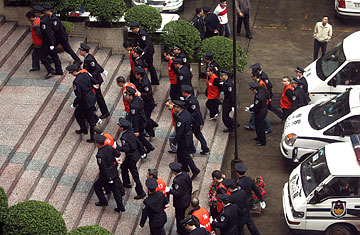
Police hustling a group of defendants into court during the height of the crackdown
(2 of 2)
Li's lawyers say his trial was hasty and that, although their statements were read into evidence, witnesses testifying against him did not appear in court to face cross-examination. A wider community of lawyers outside Chongqing asserts that the prosecution of Li is a political vendetta because he, unlike most of the other defense lawyers, fought hard for his client. "To the people who are accusing Li Zhuang — the police, the procuratorate, the court and the local government — his flaw is that he opposes them," says Tang Jitian, a Beijing lawyer and co-author of an open letter in support of Li. "They see him as someone who undermines their work and affects their performance. People like Li Zhuang basically ruined their victory banquet."
China's 30 years of reforms have helped to build up a healthy body of legislation. But Tang points out that the judicial process is still subject to the interests of the Communist Party. Indeed, in November, Chongqing's judicial bureau advised that defense lawyers in gang trials should be of "high political quality" and should "stress politics, consider the big picture and observe discipline." The apparent message: Don't get caught up in details that will muddle the overall goal of a successful antimafia campaign. That, says Tang, smacks of the Cultural Revolution, when the law, to the extent that it existed at all, was used to enforce the will of leaders.
The Antihero
Li is an unlikely icon for a civil rights campaign. A 48-year-old ex-soldier with a blunt manner, he wasn't well known among activist lawyers or even other people at his own Beijing firm. The state-run China Youth Daily, which published a long, harshly critical story about Li shortly after his arrest, painted him as brash and money-hungry, and implied that he used political connections to help his clients. Li's defenders say such criticism has nothing to do with the merits of the charges against him but is meant to sway public opinion.
The case against Li hinges on a clause in China's criminal law. Lawyers and human-rights groups say that Article 306 of the P.R.C. criminal code, which makes it an offense for a person to assist or encourage another to give false testimony, goes beyond standard perjury laws and has been used to hobble defense lawyers. If, as in the vast majority of criminal trials in China, the accused is found guilty, then the defense lawyer could be liable for evidence submitted on the client's behalf. "We are interested in this case not because of Mr. Li," says Albert Ho, a Hong Kong legislator and chairman of the China Human Rights Lawyers Concern Group. "He is not known as a human-rights lawyer and he is not active in human rights. We are interested in this case because he is apparently being victimized by Article 306 of the criminal code."
Chinese media have covered Li's case extensively, and while initial reports portrayed him as unethical, later stories examined how his case shone an unflattering light on the Chongqing trials. "Fiery Lawyer Puts China's Judiciary on Trial," wrote the liberal magazine Caixin. Prominent weeklies including Caijing and Sanlian Life Week put Li on the cover. With each story the heroic image of Chongqing party secretary Bo has taken a hit. The aggressive manner with which the trials have been pushed through has dampened enthusiasm for the campaign, says Cheng Li, an expert on Chinese leadership and research director at the Brookings Institution's John L. Thornton China Center. "It's not about the rule of law, it's not about the legal process," he says. "It's a political campaign, and it's purely Cultural Revolution – style. In a way Bo is gaining something, but he has made a lot of people uncomfortable."
The Legal Is Political
Bo is one of China's coming men. His experience as the mayor of the coastal city of Dalian, governor of Liaoning province and Minister of Commerce in Beijing all helped him build a national profile. Now he is widely thought to be in line for a possible promotion to the Politburo's standing committee, China's top ruling body, when it is reconfigured in 2012. Bo insists his goal is to clean up Chongqing; he has denied that the gang crackdown has any political motive, denouncing such interpretations as "twisted reasoning" in a Jan. 17 speech to Chongqing students, according to the state-run China Daily. But by taking the fight to Chongqing's gangs, Bo appears to have undermined his predecessor, Wang Yang, who is now party secretary in Guangdong. The two men represent two major Communist Party factions. Bo, as son of a party elder, is considered a member of the "princelings," while Wang worked his way up through the party's Youth League, the power base of President Hu Jintao. While the two groups have largely similar policy views, they are rivals for leadership within the party. By shining a light on Chongqing's corrupt underbelly, Bo has in effect raised doubts about Wang's earlier leadership, conveying the image that he let gangs grow unchecked.
How effective will the campaign against organized crime turn out to be? The crackdown has had an immediate impact on public safety in Chongqing — calls to police are down 40%, for instance — but its temporary nature means that the results are unlikely to be permanent. "It's not going to change the situation that much," says Chin, the organized-crime expert. "If they arrest 40 or 50 top gangsters, another group of people will simply replace them."
The sentiment is much the same in Edinburgh, where, despite increased attention from law enforcement, an air of fear remains. "I don't think the crackdown on the gangsters really made a big difference," says Huang, the security guard. "There is a police car that parks right down the road now every night until 10 p.m., but everybody knows that criminals only came out after midnight, so there is not much use in that." For now, Chongqing's next crop of gang lords are waiting for the moment that Bo Xilai, like the cop on the corner, decides to call it a day.
—with reporting by Chengcheng Jiang / Chongqing