

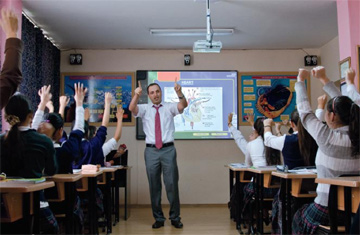
Students learn about blood circulation in biology class at a Gulen-affiliated school for girls in Kazakhstan
(3 of 3)
An Education
To my Catholic-school-trained eye, the schools I visit in Almaty and Bishkek appear familiar. They are largely segregated. Uniforms are compulsory. At the girls' school in Almaty, students wear checked skirts that are a little longer than their peers at other schools. Makeup is frowned upon, collars are buttoned and there is an emphasis on being "a good girl."
I am allowed to roam freely and speak to the students, a bright-eyed, earnest bunch who make the average Western high schooler seem terribly decadent in comparison. There are no punk kids smoking secretly in a corner, no baggy, low-waisted pants or pierced noses. They all want to be engineers and doctors "useful to my country." A group of seniors swotting for the SAT reel off a list of Ivy League schools they're applying to. I tease them by telling them about keg parties and they are mildly horrified. "I guess you can never say never," says Nazerkem Idibayeva, 16, cautiously adjusting wire-rimmed glasses. "But I don't think I will ever need beer to have fun."
The schools owe their success in part to strict control. Every minute of the day is structured. Boarding is mandatory and students live with older "brothers" and "sisters" who act as both confidants and mentors. Originally these came from Turkey but local graduates have taken over. Temsil, or leading by example, is key, not least because proselytizing in most Central Asian nations is banned. "The kids are socialized into a Muslim way of life," says Berna Turam, a sociologist at Northeastern University who has spent a decade studying the Gulen movement. "There is a very religious universe indoctrinated by extracurricular activities. That's what makes the schools like Catholic schools."
The schools also vigorously promote Turkic pride. They all teach Turkish language, and Istanbul occupies the aspirational place in students' imagination that New York City does elsewhere in the world. Unlike Western-looking Turkey, in identity-seeking post-Soviet Central Asia this blend of ethnic pride, Muslim values and secular education is welcomed. "Under Russian rule, we forgot our traditions and values," says Dana Arystanbekova, 33, who runs a large construction firm in Almaty and recently enrolled her daughter Dinara in the girls' school. "The schools have a very high level of education in English and they also teach good Turkish, Muslim values, terbiye [manners]." The schools started out free but now collect tuition — the aim being not to teach the poor but to train a future elite. Tuition in Almaty is $5,000 a year. Running a school costs about $800,000 a year and that's where businesses come in — and the tithe.
Here's how Gulen, Inc. works: in 1991 Gulen gathered several dozen businessmen from different Turkish cities and to each he entrusted a different city in Central Asia. The man from the western city of Adapazari got Bishkek, the one from Izmir got Almaty. Each sent a delegation to live there and establish businesses importing food or textiles or TVs. The group took advantage of the infrastructure vacuum created by the Soviet collapse and built up ties with officials. Eventually they were granted vacant buildings or classrooms. "Mutualism," says Sel, ever the science teacher. "The schools and businesses feed each other." Like cells, every country's program is fully autonomous, with their own office back in Turkey. Though just a two-hour drive apart, administrators in Kazakhstan and Kyrgyzstan barely knew each other.
Saulesh Kusainova, then 35, was in charge of facilities at the Ministry of Education in Almaty in 1992 when a group of Turkish men appeared in her office. They spoke neither Kazakh nor Russian but "I understood they wanted a building for a school," she says. She eventually gave them two classrooms, one each for boys and girls, and was paid with bags of cash transported from Turkey. "I knew instantly they were good, decent people," she says, taking a framed photo of Gulen, whom she calls her teacher, from her purse. "It was impossible not to be affected by them. At that time, Kazakhstan was a mess and these people came to help us." Many people I speak to cite gratitude. "Kazakhstan then was like Afghanistan today," says Muhsin Karademir, a Kazakh real estate developer. "You couldn't walk down the street because someone would pull a gun."
The schools serve to reinforce the businesses; graduates patronize them and a network of alumni builds. Restaurateur Sancak Demirci started out in 1994 with a small shop serving kebabs in downtown Almaty. Two years ago he expanded to a sleek, marbled, two-story venue, and is about to launch three franchises across Kazakhstan. "When you are called on to serve and you believe, you do anything," he says. "Imagine a kind of love beyond what you feel for your children, that's what this community shares. Whatever I own, is for the schools." He says he contributes half his monthly earnings to the cause.
Two Faces
Schools are less reliant on Turkish donors now that parents and graduates contribute. "I don't know anyone who doesn't support these guys," says Karademir. "I'm not a religious guy. But I admire the work they do. Would I have come here under those conditions? Hell, no. But they did. People recognize that and are grateful."
The movement has two faces. Pushing abroad, largely under secular regimes, it is maturing and becoming more tolerant. To be sure, the youthful men who run it abide by a strict code. (The decision makers are all men, their wives rarely work.) They believe in one truth and see everybody else as in need of saving. But they also teach children of all religions, watch Kung-Fu Panda with their students, often speak fluent Russian and jump over bonfires at Newroz, a pagan new-year tradition. "If people are scared of us," says Sel, "it means we haven't explained ourselves. To judge someone's lifestyle is up to God, not me."
Add a quest for power to that fervor, though, and it gets complicated. In Turkey the movement is insular, growing and seems to harbor a mysterious political agenda. "On one level you have activities like the schools, which are hard not to be impressed by," says King's College lecturer Park. "Then there's the political element, which appears suspicious because it's rich, secretive and nobody really knows what it's up to." Gulen says he is opposed to theocracy, yet his supporters suggest that they would like more space for Islam in public life. But how will that come to pass? The future shape of secularism in Turkey — and around the Islamic world — might rest on that answer.