

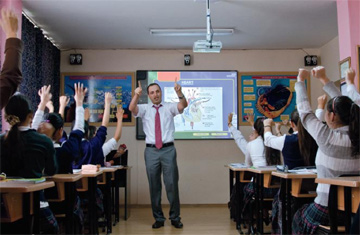
Students learn about blood circulation in biology class at a Gulen-affiliated school for girls in Kazakhstan
(2 of 3)
Emotional Appeal
Gulen's method is similar to the way in which Catholic Jesuits spread religion by emphasizing a well-rounded education. In fact, Gulen's first recruits were instructed by Christian missionaries with experience in Africa and South America. The method is also deeply controversial, and Russia and Uzbekistan have closed several of the schools. Depending on whom you ask, Gulen is either a saint or the next Khomeini (although he criticizes Iran and Saudi Arabia, for giving Islam a bad name). To followers, he is Hodjaefendi (respected teacher).
Gulen was born in a poor eastern Turkish village and began studying the Koran as a child under the tutelage of his father, a preacher. He was "electrified" as a young adult by the work of Said Nursi, a Sufi-inspired Islamic thinker of the early 1900s who emphasized the individual dimension of faith and sought to reconcile Western scientific thought and Islam. Gulen trained as a state-licensed preacher and, from 1966, he began building up a base of devotees in the western city of Izmir.
He started summer camps teaching Islamic tenets and then persuaded local businessmen to fund private dorms for low-income university students from rural areas. Students were given free room and board in exchange for a daily diet of prayer and listening to Gulen audiotapes. It was the start of a vast network of schools, universities and businesses, all promoting Islam-based ethics. He toured Turkey throughout the 1980s and '90s to cement it.
Like an American evangelist, Gulen's appeal lies mainly in his delivery. He is media savvy and emotional, frequently breaking into poetry or tears. That strikes a chord with millions of Turks who feel that modern, secular Turkey has alienated them from their Muslim belief. He also glorifies the Ottoman imperial past, appealing to a time when religion was a part of public life and the Turks were far mightier.
His is not a new interpretation of Islam — he believes that Islamic tenets as revealed in the Koran are unalterable — but he engages with modern concerns like running a successful business or how to pray while on a plane. He doesn't sport a beard and he wears suits. Since 9/11, he has made interfaith dialogue a priority. His followers hold dozens of such meetings across North America every week.
To secularist Turks, however, Gulen is a sinister figure, a puppet master readying his cadres for the great Islamist takeover. They accuse Gulen of taqiya, an Islamic concept by which believers can conceal their real intentions if circumstances so require. One oft-cited tape released in 1999 featured Gulen calling on his supporters to "work patiently" and "creep silently" into state institutions in order to gain power. He claimed his words were manipulated.
Secularist hostility makes the movement secretive. There is no reliable data on the size of Gulen's following because one doesn't sign up to join and it has no official legal status. But it is growing in power. Gulen supporters are estimated to number at least 6 million, according to academics researching the phenomenon. (More surprising is a former Interior Minister's estimate that 70% of Turkey's national police forces are Gulen devotees.) "If they were a political party, they could post 20 to 25 MPs," says Nedim Sener, an investigative journalist. "Any movement that wields that much power needs to be transparent, like an NGO. Who belongs to it? How is it funded? What goes on in the schools they run? What are its political goals? These are all issues shrouded in secrecy."