

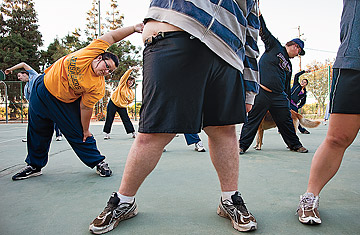
Fedorchalk, left, and Fahl, right, in hat, stretch after a walk. Most incoming students are unused to regular exercise and have difficulty completing the morning walk around campus
(3 of 3)
"This is the only area of our program that is controversial," Craig acknowledges. But he adds that kids need something they can understand, and they understand fat.
The school's self-reported 70% success rate is based on voluntary follow-up assessments with former students, most of whom agree to participate. A rate that high is almost unheard-of in the diet world. Only 7% of dieters finish Jenny Craig's one-year program, while Weight Watchers counts people who stay even a few pounds under their starting weight as a triumph. But these programs lack the comprehensive approach of Wellspring. Research indicates that therapy-based obesity treatment can be three times as effective as traditional diet-and-exercise models. But how many people can run off to rehab for six months? "The outcome is probably better [at Wellspring] than if the program were applied to the general public. The people who can go to that school are a small sliver of the population," says Kerri Boutelle, associate professor of pediatric psychiatry at University of California at San Diego.
After Wellspring
Fedorchalk and Fahl have been at Wellspring for nearly six months and have lost 72 and 82 lb., respectively. Fedorchalk dropped eight dress sizes — from a size 22 to a 14 — and although she's still considered obese at 219 lb., for the first time in her life she can shop at what she calls "skinny people" stores. She counts fat grams obsessively and adheres to her diet whenever she's at a restaurant. On a recent visit to an Olive Garden, it took her 20 minutes to find something on the menu she could eat. She is also exercising regularly. "Whenever I'd try to do a sport at home, there'd always be really skinny people who were always really good at it, and I'd feel kind of awkward," she says. "Here I can give 100% without looking stupid." In November, she and Fahl walked a half marathon.
Fahl was scheduled to leave Wellspring on Jan. 15, but he was still struggling with the program, and DeShon didn't think he was ready to come home. Two days before his departure, she told him he had to stay. "I did my part," Fahl complained. "Why can't I lose the rest of the weight at home?"
That's a lot easier said than done, of course. "It's way harder than they ever tell you it will be," says Ganzy McCorvey, 19, who lost 104 lb. at Wellspring in 2007, only to gain half of it back. "I felt really guilty making my mom eat the same things as me. And then there were my friends, who always wanted to go to Wendy's." Other former Wellspring students experienced similar roller-coaster cycles of losses and gains.
Wellspring is no miracle cure. Even the most advanced kids at the academy are far from thin. But they are healthier, and they have been empowered with the uncommon gift of hope. Nobody is destined to be fat forever, says Fedorchalk. "Even if you do mess up, even if you do fall, what matters is you get back up again. You can always start anew at the next meal."