

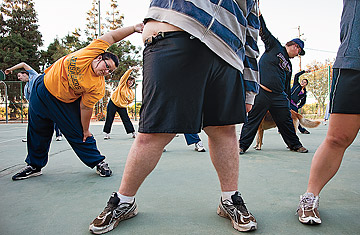
Fedorchalk, left, and Fahl, right, in hat, stretch after a walk. Most incoming students are unused to regular exercise and have difficulty completing the morning walk around campus
(2 of 3)
Every meal at Wellspring is basically a fat-free re-creation of something unhealthy. In their nutrition and cooking classes, kids learn to make mozzarella sticks with fat-free cheese and PB&J sandwiches with imitation peanut butter. They're nowhere near as tasty as the original versions, but the kids seem to like them, and at least they don't feel deprived. "A lot of parents ask me why we don't serve organic health foods," says Craig, "to which I say, Is your kid really going to eat that?"
No Easy Answers
A program as progressive as wellspring's is bound to have some kinks. Like most other weight-loss programs, Wellspring is not covered by any health insurance plan. Many families find themselves taking out loans to pay the $6,250-per-month tuition. "A lot of parents use their kids' college money," says Craig. Its prohibitively high cost makes the place inaccessible to many Americans who could benefit, especially since the highest obesity rates are found in low-income areas. But Wellspring kids are far from wealthy. Fedorchalk's mother and father, who work at a nursing home and Walmart, respectively, struggle to pay the bill. Freddy Fahl, 16, attends the school courtesy of a several-thousand-dollar student loan taken out by his mother Debi DeShon.
Fahl arrived at Wellspring in September. He was up to 351 lb., having gained 40 lb. a year for three years straight. "His weight was completely out of control," says DeShon. Last year, Fahl was even denied health insurance because of his weight. "He was 16, and I thought, O.K., I have two more years with him. Am I willing to send my child into the world at 400 lb.?"
When he stayed on the diet, Fahl lost an average of 4 lb. per week. But he found himself cheating whenever he could. While visiting his brother off campus one weekend, he went to Taco Bell and ate "almost everything" on the menu. At another outing to a restaurant, he ordered pie. Over Christmas break, he managed to lose weight, but only because his mother kept him on the program. When he returned to campus in January, he mysteriously started gaining. His therapist wonders whether he didn't smuggle in some candy.
Fahl's weaknesses mirror one of Wellspring's: its success hinges on the parents. Craig hosts family workshops and urges parents to rid their homes of unhealthy foods. Yet despite the thousands of dollars they spend on tuition, only some Wellspring parents are willing to change their behavior. In medical studies, family-based behavioral treatments have proved almost twice as effective as those that involve only the child. "You can't have a successful program if the parent is telling the kid not to eat chips while he's sitting there eating ice cream," says Leonard Epstein, a clinical psychologist and professor at the University at Buffalo.
After they leave Wellspring, students remain in contact with their therapists for six months to help them readjust to the real world. They have been spoon-fed diet-friendly meals for so long that they are often unsure how to act at birthday parties and pizza nights.
Which points to another problem: the fat-free diet. It's difficult to maintain and, over the long term, nutritionally unsound; humans need fat to survive. "People don't lose any more weight on a low-fat diet than they do on a high-fat one," says David Ludwig, director of the obesity program at Children's Hospital Boston.