

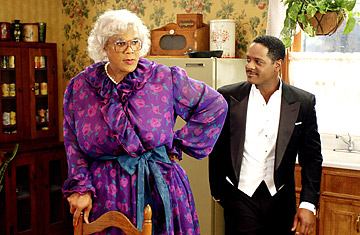
Tyler Perry, as the God-fearing granny Madea, taps into his audience's hopes and anxieties
I went to Madison Square Garden to see Tyler Perry's new musical, Madea's Big Happy Family, a day after I sat through a Broadway revival of Noel Coward's 1939 play Present Laughter. I noticed a few differences. In Coward's play, the main character, a famous stage actor, spends most of the evening in a dressing gown delivering bons mots to an entourage of fellow theater people. In Perry's show, a sharp-tongued grandmother delivers sassy put-downs and motivational lectures to a brood of squabbling family members. Coward's plot reaches a climax as the actor finds out that several pestering women have all booked passage on the same boat he's taking to Africa. Perry's culminates with the cast enlisting the audience in a sing-along of Earth, Wind and Fire hits. At the Broadway theater, I didn't see a single black face. At Madison Square Garden, I was just about the only white one.
Tyler Perry has for years operated in something of an alternate theater universe. Though best known for his hit movies (starting with Diary of a Mad Black Woman in 2005), top-rated TV series (TBS's House of Payne) and friendship with Oprah Winfrey (with whom he produced the Oscar-nominated film Precious), Perry, 40, may well be the most popular unsung playwright in America. Raised in a poor and abusive home in New Orleans, he staged his first musical play, I Know I've Been Changed, in a former Atlanta church in 1998. Two years later he introduced his most famous character, the wisecracking, God-fearing granny Mabel (Madea) Simmons — played by Perry in a plus-size print dress and silver wig. Since then he's turned out a steady stream of plays (on which his films are based) that tour the country, playing to African-American audiences on a modern-day version of the "chitlin' circuit," the segregation-era venues for black theater and vaudeville.
His stage work gets little mainstream attention. Indeed, critics were not invited to see or review Madea's Big Happy Family. I bought my own ticket and sat near the back of the nearly full Madison Square Garden theater, one of the early stops on a tour that will stretch into May. (Next week: Jacksonville, Fla.; Chattanooga, Tenn.; and Winston-Salem, N.C.) It was a bracing reminder that popular theater is still thriving in America — well under the radar and way off Broadway.
Madea's Big Happy Family, like most of Perry's work, is an odd hybrid of populist comedy-drama, rock concert, revival meeting and motivational seminar. The broad comedy, stereotyped characters and simple set (a two-story family house, living room downstairs, bedroom upstairs) give the show a TV-sitcom feel — an impression reinforced by the video screens that project the action simultaneously, even edited with two-shots and closeups.
The plot revolves around Shirley, a single mother with grown children, who learns at the outset that her cancer has spread and she has four to six weeks to live. Accepting the news with barely a flinch, she tries to tell her extended family, only to find they are too caught up in their own troubles to pay much attention. Among the brood: a son whose bitchy fiancée wants him to get into the dope trade so she'll have enough money to open a boutique and an older daughter who reveals that her younger "brother" is actually her own illegitimate child.