

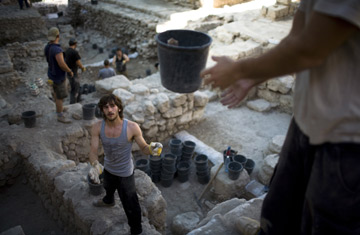
Contested ground Workers at a site in East Jerusalem have uncovered bones and other evidence of early habitation
(2 of 2)
With official Israeli backing, Elad has ambitions beyond Silwan. Lawyer Seidemann claims that since mid-2008, the Israeli government has accelerated a policy of "aggressively and covertly expanding and consolidating control over Silwan and the historic basin surrounding the Old City." The plan, he says, involves "the take-over of the public domain and Palestinian private property ... accelerated planning and approval of projects, and the establishment of a network of a series of parks and sites steeped in and serving up exclusionary, fundamentalist settler ideology." In its essence, the plan places a large area of Arab Jerusalem under Jewish control. "It risks transforming a manageable, soluble political conflict into an intractable religious war," he warns. For their part, many religious Israelis defend Elad's efforts to unearth their buried heritage. "For us, and for anyone who believes in the Bible, this is the real history," says Urieh King, a Jewish settler and activist. "These are our roots."
Welcome to Bible Land
For now, Elad's centerpiece is the City of David, a cross between an archaeological site and a Jewish theme park that draws more than 400,000 tourists a year. Visitors are led through a honeycomb of caverns and excavations propped up by scaffolding. Then they wade through an underground canal that emerges into sunlight at the Siloam pool, where Christ is said to have cured the blind. Nearly half the visitors are Israeli army conscripts and schoolkids who hear lyrical description from Elad's guides about how the site is the very foundation of Jewish culture and history. "In fact," Elad's development director Speilman boasted to Nachum News, an Israeli website, "60% of the Bible was written on this little hill."
But many experts find Elad's archaeological claims dubious. Israel Finklestein, an archaeologist from Tel Aviv University says that while there may be ruins on the Elad site dating back to the 9th century B.C., "there's not a single piece of evidence about David's palace. These people are mixing faith with science." Yoni Mizrahi, an independent archaeologist formerly with the IAA, concurs: "You'd think from Elad's guides that they'd excavated a sign saying WELCOME TO DAVID'S PALACE. Their attitude seems to be that if you believe in the Bible, you don't need proof." Raphael Greenberg, lecturer at Tel Aviv University, says Elad ignores key archaeological practices. "You're supposed to dig for six weeks and then report on what you find. In the City of David, they've been digging nonstop for two years without a satisfactory report," Greenberg says. He accuses Elad of using archaeology as a "crowbar" to "throw out the Palestinians living in Silwan and turn it into a Jewish place."
Elad's chief archaeologist, Eilat Mazar, says that "our working theory is that David's palace is down there." Mazar claims that workers have uncovered pottery shards from the 11th century B.C. and Phoenician motifs. "We know the Phoenicians built a palace for David," she says.
All excavations in Jerusalem are overseen by the IAA, and its director, ex-General Shuka Dorfman explained to TIME that while Elad manages and funds more than a dozen digs around Jerusalem, an IAA archaeologist is always on-site to analyze findings. Dorfman concedes that the settler organization's interpretation of its findings in Silwan "is different from ours." He adds: "They emphasize only the Jewish heritage." Sometimes, according to archaeologist Mizrahi, the Elad-sponsored digs ignore other strata of Jerusalem's multi-cultural history. "They're only focusing on one tradition — the Jewish one," he says.
He has a point. In 2008, it emerged that while Elad-sponsored archaeologists were digging near the Western Wall, they found and removed dozens of skeletons from a Muslim graveyard without properly documenting the find, according to Haaretz, an Israeli daily. The skeletons have since gone missing. After a barrage of complaints against the IAA by academics, Palestinians and civil rights groups, the agency's chairman, Professor Benjamin Kedar, conceded in a statement that the IAA is "aware that Elad — an association with a pronounced ideological agenda — has presented the history of the City of David in a biased manner." So far, though, the cash-strapped IAA says it has no plans to review its ties with the settlers, who are its main funders.
A Fragile Peace
Naturally, archaeology's Jerusalem Syndrome is not limited to a single religion. Many Muslim scholars refuse to believe that a Jewish temple ever existed beneath the Haram al-Sharif, or Temple Mount, even though thousands of Jews flock every day to pray at the Western Wall. The Waqf — Jerusalem's Islamic authority — made Jews furious in 1999 when they built an underground mosque inside the Haram al-Sharif and, according to irate Israeli scholars, gouged out "several hundred" trucks' worth of debris, destroying evidence that might shed light on Judaism's holiest site. "This was politically motivated," fumes archaeologist Gabriel Barkay, who leads a team of volunteers that has spent years sifting through large mounds of material from the sacred precinct that was rescued from a city dump. "In places where you should have used a toothbrush, they used a bulldozer."
But few projects threaten Jerusalem's peace as much as that at Silwan. In 2007, Arabs there began hearing strange banging under their homes "like an earthquake," one resident recalls. Soon, cracks opened up in the floors and snaked up the walls. The Silwan residents protested against the settlers' tunneling, without the necessary permits or safeguards. "All that happened was that the police arrested us," complains Jawan Siyam, a Silwan local. Elad was opening up a 650 yd.-long (600 m) drainage tunnel, running under Arab homes, that Elad claims dates back 2,000 years, and may have been used by Jewish rebels to escape a Roman siege. Civil rights groups last year got the Supreme Court to suspend the diggings. In its ruling, the court said that the local authorities had failed to obtain consent from the owners of the houses marked for demolition.
Could Elad's work upset Jerusalem's fragile balance between Islam and Judaism? Palestinian historian and Waqf religious affairs archaeologist Yousef Natsheh believes so. He points out that one of the main triggers of the 2000 Palestinian uprising — which led to the deaths of more than 5,500 Palestinians and 1,000 Israelis — was a visit to the Haram al-Sharif precinct by Sharon, then Israel's opposition leader, along with a phalanx of armed police. "The situation now is very, very tense," he warns.
It shouldn't be. Jerusalem is one of the world's richest archaeological sites. In its 6,000-year history, the city has changed hands more than 120 times. It has been ruled — and this is an incomplete list — by Jebusites, Israelites, Romans, Persians, Greeks, crusaders, Mamelukes, Ottomans, British, Jordanians and modern Israelis. "We Jews are not alone here," says archaeologist Finklestein. Would that all who treasure the holy city — of any religion and none — could agree on sharing its sacred past.
— With reporting by Yonit Farago, Jamil Hamad and Aaron J. Klein / Jerusalem
The original version of this article misidentified Eilat Mazar 'as an associate of the right-wing Shalem think tank.' Mazar no longer has any ties with Shalem.