

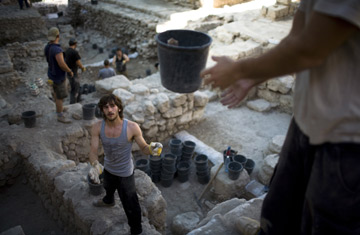
Contested ground Workers at a site in East Jerusalem have uncovered bones and other evidence of early habitation
Correction Appended: Feb. 8, 2010
The Jerusalem syndrome is a psychological disorder in which a visit to the holy city triggers delusional and obsessive religious fantasies. In its extreme variety, people wander the lanes of the Old City believing they are biblical characters; John the Baptist, say, or a brawny Samson, sprung back to life.
Archaeologists in the Holy Land like to joke that their profession is vulnerable to a milder form of the syndrome. When scientists find a cracked, oversize skull in the Valley of Elah, it can be hard to resist the thought that it might have belonged to Goliath, or to imagine, while excavating the cellars of a Byzantine church, that the discovery of a few wooden splinters might be part of the cross on which Christ died. This milder malady is nothing new. In the mid-19th century, British explorers who came to Jerusalem with a shovel in one hand and a Bible in the other used the holy book as a sort of treasure map in the search for proof of Christianity's origins.
Now an extreme case of the willful jumbling of science and faith is threatening Jerusalem's precarious spiritual balance. It could not come at a worse time: Israeli-Arab peace talks have stalled; Israel has a hawkish government disinclined to compromise; and radical Islamist group Hamas remains powerful among Palestinians. Any tilt in Jerusalem's religious equilibrium could create a wave of unrest spreading far beyond the city's ramparts. Eric Meyers, who teaches Jewish studies and archaeology at Duke University, says: "Right now, Jerusalem is a tinderbox. "
The story begins with a right-wing Jewish settler organization called Elad, but also known as the Ir David Foundation, which for the past four years has exerted control over most of the holy city's excavations. Led by David Be'eri, an ex-Israeli commando who used to disguise himself as an Arab for undercover missions in the Palestinian territories, Elad now has the backing of the Israeli Prime Minister's office, the municipality, and the vaunted Israel Antiquities Authority (IAA), which monitors all archaeological work in the country and which Elad helps finance. Elad's own funding comes through unnamed private donors. (Israeli newspapers have reported that a few Russian-Jewish oligarchs, including Chelsea Football Club owner Roman Abramovich, attended a 2005 Elad fundraiser.) The organization's aim is best expressed in a religious website's 2007 interview with development director Doron Speilman. He gestures toward Silwan, an Arab neighborhood that spills down from the Mount of Olives, and says: "Our goal is to turn all this land you see behind you into Jewish hands."
Elad's activities, in the views of its opponents, amounts to turning over Jerusalem's archaeology to extremist Jewish settlers. That has alarmed many Israeli and international scholars, Palestinian officials, and human-rights advocates. On a political level, it complicates efforts by the White House to enable both Palestinians and Israelis to share Jerusalem as their respective capitals, a key demand of the Palestinians. For scholars, it sparks concerns about whether Elad can be independent and objective in its work. And for Jerusalemites it raises a fundamental question: What matters more, the stones and bones of antiquity, or the lives of the people who live on top of all that history?
Digging In to Push Out
Because it involves burrowing near the geographic core of three faiths — Christianity, Islam and Judaism — archaeology in Jerusalem has always been fraught. All three religions believe that it was here, on a stony hill, under roiling clouds speared by light, that God stopped Abraham from sacrificing his son. Christians also believe that Jesus walked, taught and was crucified in Jerusalem, and that he rose from the dead there. Muslims say that in the early days of Islam, Prophet Muhammad prayed first in the direction of Jerusalem before turning to Mecca, and that he was once transported by a flying horse to Jerusalem where he ascended to heaven. The city is embedded in the psyche of every Christian, Jew and Muslim.
Elad's opponents accuse it of using archaeology as a means to expand Jewish settlements in Arab East Jerusalem. That would make it virtually impossible for the Palestinians to turn their section of the city into a future capital. According to Duke University's Meyers, Elad is "misusing archaeology as a tool of dispossession." Putting an ideologically motivated settler group in charge of excavations, says Daniel Seidemann, a lawyer from Ir-Amim, a Jerusalem-based civil rights organization, is like "outsourcing the fire department to a pyromaniac." (Elad founder Be'eri did not respond to repeated interview requests from TIME for this article.)
The flash point in the dispute is Silwan, an Arab village now listed in Israeli guidebooks as the City of David. It lies on the steep hillside just below the Old City's ancient, gleaming stones, facing towards the Dead Sea. Most of Silwan's Arab residents arrived in the 1930s, building homes that cling to the sides of the valley. Arab boys still canter on horses along the far hills. Some say that Job lived in Silwan, and that today's residents have inherited his ceaseless woes. According to Elad's Spielman, Be'eri was doing undercover work for the Israeli military in the mid-1980s in Silwan when a friendly Arab pointed out some ruins buried under a pile of garbage. "We know this is yours, we know this is your archaeology," the commando reported the Arab telling him.
The villager had a point. In the mid-19th century, British explorer Charles Warren, while searching for the legendary treasures of King Solomon, uncovered a shaft leading down to an underground stream. He hypothesized that this was the water source for the city founded in 1000 B.C. by the Jewish King David. This underground stream, which surfaces in the Pool of Siloam about 500 ft. (150 m) below the ancient city walls, was Jerusalem's only source of water, so it made sense to Be'eri, and to many archaeologists, that David would have built his citadel over the stream or nearby. Inspired, in part, by Warren's claims, the multimillionaire and philanthropist Baron Edmond James de Rothschild in the early 20th century bought several acres of land in Silwan.
For Rothschild, Be'eri and a succession of 20th century archaeologists the lure was a powerful one: evidence of David's reign would be proof that a major Old Testament protagonist was a true historical figure, and not mere legend. Politically, the discovery of David's citadel would strengthen Jewish claims to a contested part of Jerusalem beyond its pre-1967 borders.
Late on a chilly October evening in 1991, Jewish settlers commandeered 11 buildings in Silwan and dug in. The case went to Israel's Supreme Court and Ariel Sharon, then Construction Minister (and later Prime Minister), rallied to the settlers' defense, arguing that "it is the policy of the government of Israel to encourage Jewish residence in Jerusalem." The settlers were allowed to stay, and Elad began building its presence in Silwan. The Israeli government turned over its property to the settlers, and Elad bought up Arab homes through intermediaries. Today, more than 500 settlers, along with Uzi-toting security guards, live among Silwan's 14,000 Arabs. Elad's archaeological expansion continues, with 88 Arab homes marked for demolition to build an "archaeological park." The group also has plans for a parking lot, a synagogue, 11 new houses for settlers and a cable car to the Mount of Olives, where many believe the Messiah will arrive.