

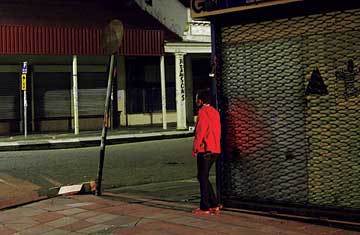
A teenage girl waits near a hotel in Bloemfontein
(3 of 3)
Such political will is not evident. At best, the South African government's response to child sex trafficking has been superficial or piecemeal; at worst, some officials have actually colluded with the traffickers. American and South African law-enforcement sources described how police at all levels have solicited underage prostitutes in Bloemfontein, Durban and other World Cup cities. South African officials claim that Parliament will pass a comprehensive law against human trafficking in early 2010. For now, enterprising police officers who take on human traffickers do so with few legal tools at their disposal. Convictions for trafficking-related offenses typically bring little or no jail time. And those vigilante humanitarians like Lombard face an emboldened and violent adversary, as I saw that evening.
Elizabeth insisted that we recover her scant possessions: a handful of clothes and a Bible. Jude had convinced her that he would perform witchcraft on those items, to track and punish her if she again attempted escape. We drove to Jude's fortified crack den five minutes away. Lombard and I followed Elizabeth into the darkness behind the compound. We were joined by Shadrack, a kung-fu-trained church volunteer who worked as a financial adviser by day. Elizabeth tapped a secret knock, and after Jude ushered her in, Shadrack wedged his foot in the door. We pushed into the dingy flat, which bore the medicinal odor of crack. As the churchmen escorted Elizabeth to retrieve her clothes, I smiled and feigned ignorance of their intent. While Lombard and Elizabeth retrieved her possessions, I spoke to Jude alone. Short and muscular, with dark, patchy skin, Jude wore slim, brown corduroys and white Crocs with green dollar signs. Jude explained that he lured girls from Johannesburg, where many survive by "picking through garbage." Our conversation turned to soccer. I asked him if he was looking forward to the World Cup. "Yeah, this is good! Us people are going to make a lot of money then if you know what you're doing."
As I prepared to leave, a woman began screaming from a sealed-off room in the compound. Lombard burst back into the room and forced his way to the darkened recesses of the compound. He kicked in a door to find Rasta, the syndicate's enforcer, half naked with the screaming woman, who ran behind Lombard. "Did you beat her? Because if you beat her, you must beat me," Lombard said, inches from the flaring eyes of the muscular Rasta. Rasta launched a haymaker at Lombard, who ducked. Rasta threatened to call in his "brothers." "I'll break their legs too," Lombard retorted as we retreated to our car, where the photographer traveling with us, Melanie Hamman, was bent in prayer with Elizabeth. With Jude chasing us on foot, we drove off.
Newly elected South African President Jacob Zuma addressed fears about sex trafficking in a speech last August. "We have noted the concern amongst women's groups that the 2010 FIFA World Cup may have the unintended consequence of creating opportunities for human trafficking," the President said. "We are putting systems in place to prevent this, as part of general security measures that we should take when hosting an event of this magnitude."
Zuma's pledge was too little, too late for Sindiswa, who died on July 22. Immediately after we took Elizabeth off the streets, Hamman and I drove her eight hours to her home in Eastern Cape. Wary of the failure rate of Lombard's unmonitored returns, we worked with a dedicated social worker in Indwe to ensure that the conditions under which she was originally trafficked did not reappear. A suburban-Chicago couple has given her a full scholarship, enabling the otherwise impossible goal of finishing school. She is HIV-negative. It is a stretch to call her lucky. But she has another chance at life.
Skinner is the author of A Crime So Monstrous: Face-to-Face with Modern-Day Slavery (Free Press, 2008), which was awarded the 2009 Dayton Literary Peace Prize for nonfiction. This investigation was supported by a grant from Humanity United.