

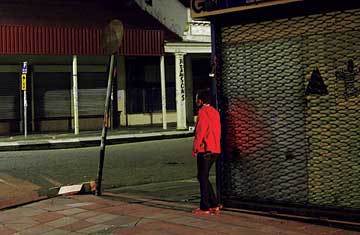
A teenage girl waits near a hotel in Bloemfontein
(2 of 3)
Although its 1996 constitution expressly forbids slavery, South Africa has no stand-alone law against human trafficking in all its forms. Aid groups estimate that some 38,000 children are trapped in the sex trade there. More than 500 mostly small-scale trafficking syndicates — Nigerian, Chinese, Indian and Russian, among others — collude with South African partners, including recruiters and corrupt police officials, to enslave local victims. The country's estimated 1.4 million AIDS orphans are especially vulnerable. South Africa has more HIV cases than any other nation, and a child sold into its sex industry will often face an early grave.
As Sindiswa told me her story, her voice trailed off, and the man who brought me to her — Andre Lombard, 39, a pastor of the Christian Revival Church — laid his hands on her. Lombard had a penetrating gaze and a simmering rage toward men who abuse women. His father, a brutal drunkard, had beaten his mother regularly. Lombard became a born-again Christian at age 17, then served in South Africa's élite special forces for 11 years.
He began a street ministry in April 2006 and recruited some 60 volunteers to distribute food, blankets and Bibles to the dozens of women and girls selling sex within a 10-block radius of the stadium. They also preached to clients and traffickers. Fights were commonplace. Lombard allowed his volunteers to carry firearms, and several wound up in the intensive-care unit of the local hospital. Lombard acknowledges that most of the prostitutes were not enslaved. Still, in a controversial move, he purchased bus tickets home for more than two dozen women as a way to "escape the streets." With no comprehensive rehabilitation, however, several wound up back in prostitution. Mainstream antitrafficking organizations often decry such tactics as reckless. In response, Lombard says, "I'm a goer. If you drive by and just talk about it and don't do anything, you're actually justifying it."
After we left the hospice, Lombard drove eight blocks east of the stadium to the notorious Maitland Hotel. Police had identified the Maitland as a base of drug- and human-trafficking operations. HIV-positive survivors described how traffickers used gang rape, drug provision, sleep deprivation and torture to "break" new children on the fifth floor; the fourth floor featured an illegal abortion clinic. On other floors, as many as four girls slept on a single mattress. Police raided the Maitland in 2008 and shut the place down last January. Traffickers had been tipped off about the final raid, yet officials still rescued dozens of underage girls and seized weapons and thousands of dollars' worth of drugs. Though still officially closed, the Maitland was active. Next door, a club blasted music by Tupac, and several girls worked the front of the hotel, where a makeshift concierge took rents.
A shivering girl in a red sweatshirt and flip-flops stood alone at the corner of the hotel. She said she was 15 and desperately needed help. I asked Lombard's volunteer to translate from Xhosa. Shockingly, this was Elizabeth — Sindiswa's best friend — still controlled by Jude. Having researched modern-day slavery for eight years, I knew how difficult it was for survivors to heal after emancipation. In this case, mere emancipation would be a dangerous procedure.
Earlier that day, I spoke with Luis CdeBaca, who was visiting South Africa on his first foreign visit as President Obama's ambassador-at-large to monitor and combat human trafficking. "Dedicated cops, prosecutors and victim advocates are fighting the traffickers in several host cities, but they're largely doing it on their own," he said. Obama has pledged to make the fight to abolish modern-day slavery a top foreign policy priority, but the U.S. currently spends more in a single day fighting drug trafficking than it does in an entire year fighting human trafficking. So CdeBaca, whose office evaluates every country based on its efforts to fight human bondage, must rely largely on diplomatic pressure. "An exploitation-free World Cup will require resources and political will from the South African government and the international community alike," said CdeBaca.