

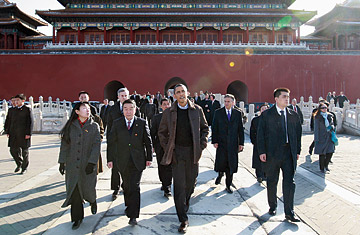
President Obama's trip to China stressed the U.S. and China's economic ties.
Having spent a week in Asia and three intense days in China, President Barack Obama set a constructive tone for the future. He welcomed the emergence of China as a new force in the global economy and rebuffed suggestions that its rise should be seen as a sign of American decline. Chinese officials expressed concern about a weak dollar but committed to working with the U.S. to stabilize the global system. Hardly anything concrete was accomplished, but the trip cemented the centrality of the U.S.-China economic relationship and the fact that the two economies are, for now, intertwined.
Nonetheless, as Obama returns to pressing domestic issues and international flash points such as Iran and Afghanistan, two awkward numbers linger in the background: 3.5 and 8.9. The first is the rate of growth for the U.S. in the third quarter of 2009; the second is how fast China grew. And while GDP statistics are a flawed indicator, the contrast between the two economies remains stark.
China has been on an unconventional and unexpected journey that began after the tragedy of Tiananmen Square 20 years ago. The U.S., after half a century of global economic dominance, finds itself at a crossroads, unable to generate the growth that so many Americans expect and the services so many need, and still struggling to revitalize an economy that for so many years was the envy of the world. The U.S. has been accumulating debt and owes about $800 billion to China alone; China has been building reserves and now has in excess of $2.2 trillion. China remains a poorer country on a per capita basis but is rapidly becoming an economic superpower. The U.S. is one of the most prosperous and stable countries in the world, but its system is showing signs of age.
Both Chinese and Americans view their economic interdependence warily. Yet in many respects the relationship has been mutually beneficial and may have been the primary reason the financial crisis did not result in a worldwide Great Depression. China was able to spend aggressively because for 20 years U.S. businesses had been investing in the Chinese economy, building factories, adding liquidity to Chinese banks, opening stores ranging from Avon boutiques to Kentucky Fried Chicken outlets, making cars, selling power turbines and semiconductors — all of which were essential to the rapid urbanization and modernization of China and the emergence of a vibrant middle class.
Scrap Metal and Bridal Gowns
You could throw a dart at a chart of S&P 500 companies and come up with a China story. Intel is spending hundreds of millions of dollars to build a gleaming new factory in the northern Chinese city of Dalian. Nike signed up Chinese basketball wunderkind Yao Ming and then a gaggle of élite Chinese athletes to become the most popular sports brand in the country, growing 22% this year in China compared with barely 2% in the U.S. FedEx invested billions in logistics in China and the Pacific Rim, not just enabling foreign companies to function more smoothly but also exporting knowledge of modern shipping in the process. The cumulative result was a transfer of capital, yes, but more vitally of knowledge that has been the key to China's success.
But the benefits have flowed in both directions. Take Walmart. By some estimates, over the past several years, the retailer alone has accounted for 15% of U.S. imports from China, which would mean in excess of $30 billion this year. As those goods enter the port of Long Beach, Calif., they require American workers to offload them, American trains and trucks to ship them and American workers to sell them. None of those facts are visible in the trade statistics, yet they are real. And take a company like Schnitzer Steel of Oregon, a once regional company that collects and sells scrap metal. Had it not been for Chinese demand driving up the cost of scrap, Schnitzer would not have seen the soaring profits that allow it to employ more than 3,000 people. Or consider the Greek-American businessman I sat next to on a long flight to Hong Kong who was able to turn his small wedding boutique into a regional chain with his own line in department stores because of the efficiencies that flowed from making his dresses in China. Those stores employed American workers and helped women of modest means realize their wedding dreams. You could fill a year's worth of magazines with similar examples.