

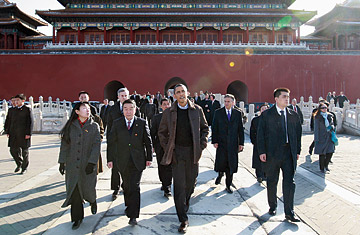
President Obama's trip to China stressed the U.S. and China's economic ties.
(2 of 2)
And yet it's fair to say that the relationship between China and the U.S. is not something that most Chinese or Americans like. Say China to many Americans, and they will speak of cheap and potentially dangerous products, unfair trade practices, human-rights violations and outsourcing. Mention the U.S. to many Chinese, and they will speak of arrogance, mismanagement of the economy and hypocrisy. One of the most popular books in China this year is China Is Not Happy, and the source of that unhappiness is an overly dependent relationship with the U.S. The two governments share some of those anxieties. Beijing worries that the continuing struggles of the U.S. economy will impair a $338 billion market for its exports and imperil its dollar-denominated investments. China pegged its currency to the dollar years ago in order to hitch its wagon to the world's most dynamic economy but today worries that a declining dollar will impede China's growth. Many in Washington and on Wall Street believe that China's currency policy gives it unfair advantages in trade and that its reliance on state spending rather than domestic consumption is a core cause of the global economic crisis.
Chicken Parts and Tires
But the same Americans who speak darkly of the China effect routinely seek out the least expensive cell phones, televisions and clothing and demand that companies whose stocks they invest in show double-digit profit growth. Procter & Gamble needs the supercharged gains of its Oil of Olay brand in China to remain compelling to investors. The Otis Elevator Co., a unit of United Technologies, makes great elevators, but it's China that's erecting thousands of skyscrapers. And the same Chinese who snap up copies of China Is Not Happy seek business deals with American companies, crave access to U.S. intellectual property and hunger for the brand-name goods produced by American multinationals.
Other than complain, there's little either can do to halt this integration. Punitive tariffs backfire. The Obama Administration's 35% tariff on imports of Chinese tires potentially hurt Goodyear's operations in Ohio because the company had developed a cost structure that uses production in China as a way to maintain its U.S. operations. China threatened to retaliate with tariffs on U.S. chicken parts. If tires and chicken parts are the worst of it, so much for trade wars.
The emergence of China will shape the world much as that of the U.S. did in the late 19th century. What remains to be seen is whether the rise of China will complement the U.S. or undermine it; whether the future will bring a new, cooperative and mutually beneficial economic order rather than a predictable replay of one great power giving way to the next. That future — burgeoning with possibilities and fraught with challenges — is ours to write.
Karabell is the author of Superfusion: How China and America Became One Economy and Why the World's Prosperity Depends on It