

(5 of 8)
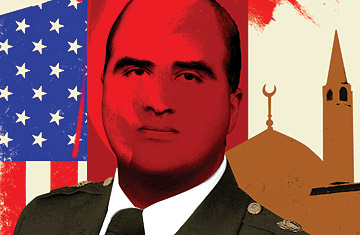
The first alarms began to sound while he was still in training. "He was very vocal about being a Muslim first and holding Shari'a law above the Constitution," says an officer who attended the Pentagon's medical school with Hasan but would speak only off the record because his commanders ordered him not to discuss the case. "When fellow students asked, 'How can you be an officer and not hold to the Constitution?,' he'd get visibly upset--sweaty and nervous--and had no good answers." This officer was so disturbed when Hasan gave a talk asserting that the U.S. was waging a "war on Islam" that he challenged the lieutenant colonel running the course. "I raised my hand and asked, 'Why are you letting this go on? This has nothing to do with environmental health,'" which was the actual focus of the course. "'I'm just going to let him go,'" replied the lieutenant colonel, who had even approved the topic in advance.
"It was a systemic problem," the officer says. "The same thing was happening at Walter Reed." The vital question for the military and our own security is whether political correctness--or the desire to protect diversity--prevented the Army from recognizing and dealing with a problem in its midst, a problem in plain sight. According to a co-worker, Hasan would not even allow his photo to be taken with female colleagues. "People are afraid to come forward and challenge somebody's ideology," explains Hasan's classmate, "because they're afraid of getting an equal-opportunity complaint that can end careers." NPR reported that top officials at Walter Reed held meetings in the spring of 2008 in which they debated whether Hasan was "psychotic." "Put it this way," an official told NPR. "Everybody felt that if you were deployed to Iraq or Afghanistan, you would not want Nidal Hasan in your foxhole."
Preacher and Provocateur
Hasan's path began to twist about the time he attended the Dar Al-Hijrah mosque in Falls Church, Va., one of the largest mosques on the East Coast and home to a charismatic Islamic cleric named Anwar al-Awlaki. Born in New Mexico in 1971 to Yemeni parents and educated at Colorado State University, al-Awlaki was often portrayed as a mainstream, moderate Muslim cleric who asserted that terrorists claiming to be good Muslims had "perverted their religion." But the perception of al-Awlaki shifted as intelligence officials began connecting the dots: they found that he had raised money for Hamas, had met with two of the 9/11 hijackers at his previous mosque in San Diego and had some association with other extremist groups. In April 2001, two 9/11 hijackers worshipped at al-Awlaki's Virginia mosque; the next month, Hasan held his mother's funeral there, though there is no evidence that the two men met.
In 2002, al-Awlaki left the U.S. and eventually returned to Yemen, where his humor, charisma and technological savvy helped him develop a global reputation as an intellectual blood bank for aspiring martyrs. The Fort Dix Six are said to have listened to his sermons, as are some of the Minneapolis youths who traveled to Somalia to join the al-Shabab terrorist group. And last December and January, surveillance of al-Awlaki revealed that he had received as many as 20 e-mails from Hasan.