

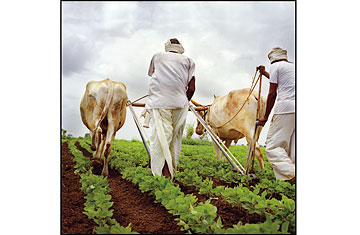
Sowing success
Small farmers, like these in India's Vidarbha region, need better technology to boost production
(3 of 3)
Three years later, K.S. Mulay, a state agricultural officer based in the Vidarbha town of Amravati, proudly reads off a long list of the progress the government has made so far. Nearly $39 million has been spent subsidizing high-yield seeds, Mulay says, plus $24 million on developing fruit orchards and other pricey produce, and another $24 million on building micro-irrigation projects. As Mulay drives down narrow roads through Vidarbha's cotton fields, he stops his jeep every few miles to show off the government's handiwork. First, he marches up a muddy hillside to a small dam the government built to help farmers preserve monsoon rainwater — one of more than 9,000 constructed in the region over the past three years. Next he visits the farm of Bhiamrao Mahore, who received free orange-tree saplings from a state-funded nursery. Mahore hopes his oranges will bring more money than the cotton he had planted before. Next stop is a state-sponsored training session where scores of local farmers collect for a PowerPoint presentation on how best to protect crops during a drought. "We are trying to increase the income and productivity of the farmers," Mulay says. "All the work cannot be done in three years. But it is a beginning."
And, for now, just that. Some Indian economists criticize the government for spending too much on welfare programs, such as the job-guarantee scheme, and not enough on irrigation systems and other investments that could make farms more productive. "Giving a cow won't help a farmer long-term," says Paurnima Sawai, 42, a farmer in Takarakhede Shambhu village. "But money to build a dam is a long-term investment. For years, you get benefits from it." With only 40% of its farmland irrigated, India's entire economic boom is held hostage by the unpredictable monsoon. With much of India's farming areas suffering from drought this year, the government will have a tough time meeting its economic-growth targets. In an August report, Goldman Sachs predicted that this year's weak rains could cause agriculture to contract 2% this fiscal year, making the government's 7% GDP-growth target look "a bit rich." Even Thakare, with his pond, may not have enough water to plant his extra crops this year. Abusaleh Shariff, a senior fellow at IFPRI's New Delhi office, argues that allocating money is only part of the government's task. The farmers also need better training, technology and marketing opportunities. "Do we have any of these? Almost none," Shariff says. "The government program needs to be improved, and we need to devote a lot more resources."
Nature vs. Nurture
Tulasidas mandase of bivara barsa village in Vidarbha couldn't agree more. Though he has received aid from the government, Mandase, 38, complains that it hasn't been the right kind. The state donated a metal plow and a pesticide sprayer, but neither worked. To get subsidized soybean seeds, he spends a full day traveling by bus to a nearby town. It often takes two or three trips, and, with bus fares costing him 60 per roundtrip, he wonders if the cheaper seeds are worth the effort. What he really requires, he says, is better infrastructure to make him less dependent on the monsoon. Mandase believes that he might need a deeper well and electricity to run a pump — investments he could never afford on this own. In lieu of that, Mandase, with the local monsoon spotty, can only pin his hopes on divine intervention. In late July, Mandase visited a Hindu temple near his village and offered a coconut to the gods. He then split it, left half on the altar and took the other home to eat. The puja, or religious rite, is meant to bring rain. "All I need is water," Mandase says.
Kishor Tiwari believes the farmers require much more than that. The Nagpur-based activist, whose organization, the Vidarbha People's Protest Forum, has championed the region's cotton growers, says that the package has alleviated some of the farmers' distress. But Tiwari says that more government intervention is needed to solve the real underlying problem: a global agricultural market rigged against the small tiller. While the costs of crucial inputs, like fertilizer, have been rising, global prices for cotton are being depressed to an artificially low level by U.S.-government subsidies for its cotton farmers — a one-two punch, he says, that makes profitable farming in Vidarbha practically impossible. "The input prices are set by someone else while the purchase prices are set by someone else," Tiwari says. "That's why the farmers are killing themselves." He wants the Indian government to better defend its own farmers by providing heavier subsidies for cotton production, protection from imports, easier access to finance and price supports. "If the government forces the farmers to have better productivity, it should have an integrated approach that is devised to have more profitability," he says.
Yet Tiwari's protectionist approach could actually hurt farmers. The World Bank's Delgado says that most projections show trade liberalization in agriculture would create significant increases in prices — as much as 20% for cotton and 7% for food grains. Not only would those gains increase the incentive for farmers to grow greater quantities of food, but they would also put more money in farmers' pockets, creating a new source of global demand. But with World Trade Organization negotiations on agricultural trade stalled on the issue of subsidies, it seems unlikely that farmers in Vidarbha and elsewhere will see these benefits anytime soon.
Policymakers can't afford to wait. The FAO forecasts that food production will need to double by 2050 in order to keep up with rising demand, a task that will require $30 billion of investment annually. "Governments are scrambling to fix some of the problems, but it will take time," says Akmal Siddiq, a natural-resources economist at the Asian Development Bank in Manila. Farmers like Namdeo Sidam, 48, know that all too well. He, his wife and three sons live in a mud-walled shack in the fly-infested village of Marathwakadi in Vidarbha, and aside from a free plow, the government's ample funds have yet to trickle his way. Sidam gets no subsidies for his seeds, no guaranteed rural work has been available in the area and no new water resources have been developed near his farm, nor did he get state help with his $350 debt. Government agricultural officials hardly ever visit the village, he says, and he appears uninformed about the new initiatives that might help him. He is still dependent on the cotton crop he grows on his small farm, supplemented by the wages his sons can earn in part-time jobs. "Not much has changed," he laments. To make the new Green Revolution a reality, the global community still has much backbreaking farm work to do.
— with reporting by Nilanjana Bhowmick / New Delhi, Chengcheng Jiang / Beijing, Yuki Oda / Tokyo, Shashikant Sawant / Nagpur and Joost Van Egmond / Dakar