

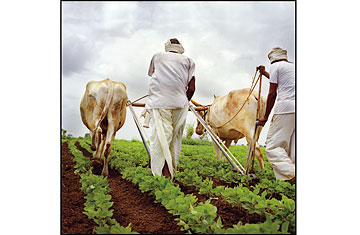
Sowing success
Small farmers, like these in India's Vidarbha region, need better technology to boost production
(2 of 3)
The food crisis spurred global leaders into action. "There seems to be an awareness that [food security] is one of the fundamental issues in the world that has to be dealt with," says Christopher Delgado, policy adviser on agriculture and rural development at the World Bank in Washington. In a July report, a committee of British parliamentarians called on their government to invest in agricultural research and encourage local farmers to grow more fruit and other produce. The U.S., which traditionally provisioned food aid from American grain surpluses to help needy nations, is moving toward investing in farm sectors around the globe to boost productivity. "If we can help countries become more productive for themselves, then they will be in a better position to feed their own people," U.S. Secretary of Agriculture Tom Vilsack said in June.
The New Green Revolution
Africa, which missed out on the first Green Revolution due to poor policy and limited resources, is also witnessing the beginnings of real change. In Senegal, 2008 protests sparked by rising food prices scared the government into instituting a program to make the country of 12 million people less dependent on imported grain. Grandly named the Great Agricultural Offensive for Food and Abundance, or GOANA, policymakers aimed to boost local agricultural production by subsidizing seeds, doling out farm implements and speeding up irrigation investments. The program convinced Ngor Sarr, a subsistence farmer in the region of Fatick in western Senegal, and the other members of his agricultural cooperative to expand their paddy fields last year. Though the seeds he received through GOANA weren't of top quality, leading to mediocre yields — a common problem with the program, critics contend — Sarr's rice output increased enough to encourage him to join GOANA again this planting season. The new government scheme "gives us the chance to do something extra, to try and expand our fields, and that's very good," Sarr says.
The renewed focus on the farm is being driven by more than fear. Development experts believe a new approach to farming is crucial in order to lift up the world's remaining poor, 75% of whom live in rural areas. Swayed by the success of East Asia, the primary poverty-fighting method favored by many policymakers was to get farmers off their farms and into modern jobs in factories and urban centers. But that strategy has proven insufficient. Income levels in the countryside badly trail those in cities in many countries, while the FAO estimates that the number of poor going hungry in 2009 reached an all-time high at more than 1 billion. "The bottom of the pyramid really depends on agriculture," says Suresh Babu, senior fellow at the International Food Policy Research Institute (IFPRI) in Washington. "There is no other way to bring them out of poverty except with agriculture."
India is a salutary case study for its renewed commitment to agriculture — Prime Minister Manmohan Singh called for "another Green Revolution" in his Aug. 15 Independence Day speech — as well as for how much still needs to be done. In 2004 politicians in New Delhi got a wake-up call on the plight of the country's farmers. The ruling Bharatiya Janata Party (BJP) ran for re-election in 2004 with a campaign slogan of INDIA SHINING, aimed at capitalizing on the country's astounding record of rapid growth. But India's struggling farmers didn't see much shining in their own lives, and voted the BJP out. The unacknowledged reality was that the farms hadn't yet joined in India's economic boom. While GDP grew on average 5.7% a year between the launch of India's market reforms in 1991 and 2004, agriculture slumped along at just 2.9%. Indian farming had also become miserably inefficient. Each hectare of cultivated land in India produces half that grown in Thailand. "The government thought that after liberalization, agriculture would grow automatically, that money would go from industry" to the farms, says Shreenivas Khandewale, director of the R.S. Ruikar Institute of Labor and Socio-Cultural Studies in Nagpur. "But it didn't come."
Growth Model
When the indian national congress took power in 2004, Singh changed course and began an intensive effort to improve the lot of the nation's farmers. Between the 2003-04 and 2008-09 fiscal years, the central government's budget for agriculture quadrupled. Government schemes built rural roads to help farmers get their produce to market, forgave some of their debts and raised minimum purchase prices on cotton, rice and other crops. In 2005, policymakers launched the Bharat Nirman program, aimed at providing electricity, housing and irrigation systems to the country's farmers, and, a year later, the National Rural Employment Guarantee Scheme, which promised at least 100 days of work each year for poor farming households, often on public-works projects to develop infrastructure in the countryside. In the latest federal budget, announced in July, funds allocated for the rural jobs scheme jumped 144% from the previous year to more than $8 billion — making it the largest social-welfare program in the budget — while funding for Bharat Nirman was boosted by 45%. "It was very clear to us that if you want inclusive growth, it is going to require a significant increase in the productivity of land," says Montek Singh Ahluwalia, deputy chairman of India's Planning Commission in New Delhi.
Perhaps no single region of India's vast hinterland has received more concentrated government attention than Vidarbha. One of India's more distressed farming regions, Vidarbha became infamous for its high rate of farmer suicides. The problem became so severe in 2006, when more than 1,250 took their lives, that Singh toured Vidarbha and announced a special $780 million development program for the area, which the locals refer to simply as "the package."