

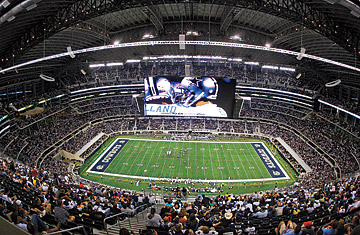
The new Dallas Cowboys Stadium, with its 160-ft.-long screen
(3 of 3)
Though Jones wanted his new stadium to be an icon, he stopped short of hiring name architects like Peter Eisenman, Norman Foster or Herzog & de Meuron, the guys who have added star power to stadium design over the past few years. Why butt heads with a big thinker when you've got some big thoughts of your own? "We really knew what this building was going to look like," Jones says. "What I needed was a good listener."
So he turned instead to Bryan Trubey of HKS Architects, a Dallas-based firm, and together they came up with an adroitly glamorous exercise in how to balance muscle and lightness. The muscle comes from the main structural supports of the stadium's retractable roof, a pair of massive single-span steel arches, each a quarter-mile in length, that plant their big feet in concrete boxes just outside the exterior walls. The lightness comes from 180-ft.-high glass doors set between the arches on two sides of the stadium. Those let in an exceptional amount of natural sunlight for a climate-controlled environment and give anyone approaching the building a clear vista straight across the field and out the other side. After the infernal summer weather leaves town, a line of glass doors at each end zone can slide away to admit real air into the place.
Not many of the architectural features of the new stadium are groundbreaking in themselves. The best of them are smart adaptations, well deployed. In particular, the arches and glass walls call to mind the new Wembley Stadium in London, a Foster design that Jones liked enough to visit three times on idea-gathering travels he and his wife Gene made to stadiums, airports and even shopping malls. Over the past few years, Gene also headed a project that commissioned site-specific works for the stadium by artists like Franz Ackermann, Mel Bochner and Olafur Eliasson, museum-quality names whose work you don't usually find in a building with a retractable roof. "I just thought it would be great to have art that's not just football art," she says. "To have something that's very contemporary, like the building, very cutting-edge."
Around much of its exterior, Cowboys Stadium is covered in sloping bands of fritted glass that reflect the shifting blue and silver-gray of the Texas skies. And as Jones is happy to remind you, "Those are the colors of the team!" Spend enough time with him, and you may end up convinced that the whole of creation was designed to color-coordinate with the Cowboys jerseys. But at the end of the day, the real Cowboys color is dollar green.