

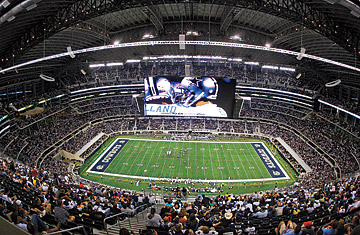
The new Dallas Cowboys Stadium, with its 160-ft.-long screen
(2 of 3)
Something else about Jones' stadium is big: the prices. Like baseball parks and basketball-hockey arenas, football stadiums have for decades been evolving into places where an increasing amount of the real estate is devoted to premium-priced seating. In that department, Cowboys Stadium is the new frontier. About a third of the base seating capacity of 73,000 consists of suites--325 of them--and high-priced "club seats" with access to various bar-lounges at escalating levels of luxury. Those seats require that you first buy a 30-year license, which costs between $16,000 and $150,000, depending on sight lines and your desired degree of excess. And that sum doesn't include the cost of season tickets that range from $59 to $340 per game for those seats. Team Marketing Report, a sports-business publisher, maintains a Fan Cost Index, which is the average cost for a family of four to purchase tickets, food and drink, programs, caps and parking. For the league as a whole, that number is $412.64 per game. For the Cowboys, it's a whopping $758.58, largely because the average ticket price, $159.65, is more than twice the league average.
You can get in and out cheaper than that, but it comes with a catch. Terraces behind each end zone have been set aside as standing room for $29 a head. The Cowboys call those tickets "party passes," because standees get to mill around, chug beer and do their own sack dances if that's what they're in the mood for--they're the sports-world equivalent of free-range chickens. But knowing that the most affordable tickets don't actually get you a seat does nothing to discourage the suspicion that even fewer than that 7% of all fans will be able to see games live and that pro football is headed the way of opera as an indulgence for people in the top tax brackets.
All the same, there must be quite a few of those people, because even in a sluggish economy, the new stadium is close to selling out. By mid-September, the Cowboys were reporting that 95% of their club and reserve seats have been sold to season-ticket holders. That's all the more impressive when you remember that the Cowboys, who ruled the NFL in the early '90s, barely rule Texas these days. Between 1972 and 1996 they won five Super Bowls, three of them in the years after Jones bought the team in 1989 and started fiddling energetically with the coaching staff and the roster. But 1996 was the last time the 'Boys won a playoff game, and they finished last season with a lackluster 9-7 record. Yet in one respect they still rule--Forbes magazine estimates they're the most valuable franchise in sports, worth $1.6 billion, given the willingness of Cowboys fans to pay up no matter what happens on the field.
The Cowboys have been a tremendous investment for Jones, 66, who bought the team for just $150 million. With revenues of $280 million in the 2008 season, they rank third in revenues in the NFL, after the Washington Redskins ($345 million) and the New England Patriots ($302 million). In June the Dallas Morning News estimated that if the Cowboys draw an average of 80,000 visitors to their eight regular-season home games this year, Jones could see those revenues climb to about $360 million. The paper estimated that about $60 million of that increase would come from those pricey club seats and suites.
I have seen the future, and it certainly works for Jerry Jones.
Made in Texas