

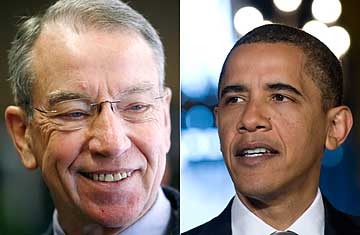
Senate Finance Committee ranking member Sen. Charles Grassley, left, and President Barack Obama.
(3 of 3)
Grassley has the upbeat, Hawkeye stubbornness that Meredith Willson, who hailed from the county next to the Senator's, made famous in The Music Man. He is one of the few people still arguing that a grand bipartisan deal is possible--though he suggests that the way to get there is through a Democratic surrender. "There's a feeling that the only way to get a bipartisan agreement is to defeat a Democratic proposal on the first hand, and then the Democrats will come to Republican leadership, and then, at that point, they'll know the only way they're going to get health-care reform is bipartisan," he recently told Iowa reporters.
The Democrats, no surprise, have different ideas. In fact, party leaders are ready to write Grassley and the Republicans out of their plans for action in September and October. "If we can't do a bipartisan bill, we can do a partisan bill," says Senate majority leader Harry Reid. That may be harder than it looks. Though Democrats control Congress, it takes 60 votes to get past a filibuster in the Senate; with the death of Ted Kennedy, they have only 59. And holding the Democrats' own ranks is getting dicier, given the sinking poll numbers for both Obama and his health-reform effort--particularly among women and voters over 65, who worry that Washington's fixes will only hurt the quality of the care they've got.
There are procedural ways to get around the 60-vote hurdle, but going that route with a bill as big and complicated as health-care reform would take the Senate Democrats into dark, uncharted parliamentary territory. Among the options they are considering are cutting the bill into pieces and ultimately passing a smaller and less ambitious measure. That, however, sets up a clash with the more liberal House.
In this ugly landscape, the White House has come to realize that the President himself is going to have to play a more forceful and direct role--and soon, including an address to a joint session of Congress on Sept. 9. Rather than leaving the legislative sausagemaking up to Congress, allies say, Obama will have to become far more specific about what he wants to see in a bill. He must spell out, for instance, precisely what he means by a public option, an issue that has grown to outsize proportion as an ideological flash point. The President may also need to declare whether he would be willing to sign a bill without one.
Grassley believes the raucous town meetings of August made it clear that Obama now faces something far larger than mere doubts about health-care reform. "I was expecting a lot of anger, but what really surprised me about the town meetings was the fear that people were expressing--afraid for the country. Health care was a big issue, yes, and it took up most of the questions at the town meetings. But it seemed to me it was the straw that broke the camel's back. People were bringing up the stimulus bill not doing any good and [costing] $800 billion. Or the Federal Reserve shoveling $2 trillion out of an airplane and not seeing it does any good. And the nationalization of banks and [General Motors]."
Fear, Grassley argues, is part of the process too. "Democracy is at work," he says. "The public hearings have had an impact. Exactly to what extent? I'll have to get back [to Washington] and talk to my colleagues." The question is whether anyone on either side is still willing to listen.