

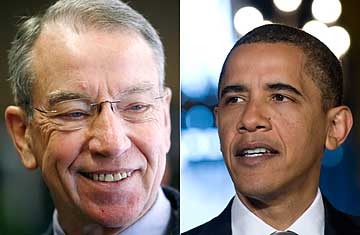
Senate Finance Committee ranking member Sen. Charles Grassley, left, and President Barack Obama.
(2 of 3)
Then again, Grassley, who will be 76 this month, has always been a free spirit. He still lives in the Butler County precinct where he was born, farming 710 acres of corn and soybeans with his son and making a point of holding at least one meeting a year in each of the state's 99 counties. Ever thrifty, he coasts his 13-year-old Lincoln (bought used, of course) down the ramp to his spot in the Hart Senate Office Building garage to save on gas. As a Senator, he bucked President Bush to work with Baucus and House Speaker Nancy Pelosi on the State Children's Health Insurance Program in 2007. He has also championed government whistle-blowers and launched probes into the tax status of (GOP friendly) Evangelical preachers. That independence helps explain why he is easily Iowa's most popular politician, winning re-election four times. "Everybody trusts Chuck in Iowa," says former Iowa Congressman Jim Leach.
Yet Grassley is not immune to the pressures from his party. Iowa Republicans have been trending rightward; socially conservative Arkansas governor Mike Huckabee won last year's presidential caucuses there. Opposition groups have been running ads in the state criticizing Grassley for his role in the health-care negotiations, and back in Washington, Senate GOP leaders have made no secret of their anxiety about it. "Senator Grassley has been given no authority to negotiate anything by all of us Republicans on that committee," said Jon Kyl of Arizona, the Senate GOP whip. What's more, Grassley's term as ranking Republican on the powerful tax-writing panel will expire at the end of 2010; he stands to assume that spot on the Judiciary Committee, but the Republican leadership could block him from getting it. Things have become so uncomfortable for Grassley at times that he has mused privately about retiring, telling colleagues, "Maybe I should just go home and ride my tractor."
In an interview on Sept. 1, Grassley said, "I've gotten pleadings that we're helping the Democrats get a bill." But, he insisted, "my posture has been to take to the table things that my caucus has said they want health-care reform to be or not be." Among the demands that Grassley says he has made that reflect his commitment to conservative orthodoxy: no rationing of health care, no government-run public option to compete with private insurance, no requirement that employers provide health coverage and an insistence that malpractice lawsuits be curbed.
Hawkeye-Stubborn
But if Grassley has been clear about what he doesn't want to see in a bill, Democrats have had a harder time getting a fix on what he might accept. Take his often repeated criticism of the public option: Obama expected it to come up during a private meeting with Grassley last spring and was prepared to explore a compromise, according to a source who is familiar with what happened. Instead, Grassley failed to even mention it, leaving it to Obama to bring up the matter--and his top aides to wonder what Grassley's real agenda was.