

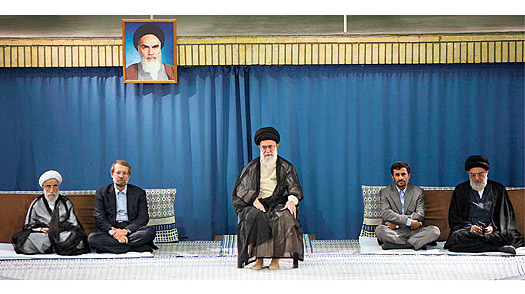
As turmoil spreads, the Supreme Leader taps one family to step in.
(2 of 3)
The brothers' politics varies. "Javad is more forward-leaning and entrepreneurial in his politics. Ali is the most ambitious, and Sadegh is the craziest," said Suzanne Maloney, a former State Department analyst now at the Brookings Institution's Saban Center. Mohammad Javad was burned politically by published reports about his meeting with a British diplomat in the late 1990s to defuse Ayatullah Ruhollah Khomeini's fatwa condemning The Satanic Verses author Salman Rushdie to death. Educated at the University of California, Mohammad Javad has also expressed a relatively moderate position on relations with the U.S. "We should regard our relations with America realistically and without extremism and weigh them with the criteria of our national interests," he said a decade ago. Sadegh, meanwhile, served on the 12-member Council of Guardians, the powerful body that vets legislation, political candidates and election results. Now, as chief judge, he is expected to oversee the judicial crackdown and trials of opposition figures.
Realists vs. Hard-Liners
The Larijanis reflect a nuanced but significant difference from the hard-line "principle-ist" politics of Ahmadinejad. "Ten years ago, the Larijanis would have been considered arch hard-liners," said Karim Sadjadpour of the Carnegie Endowment for International Peace. "But the spectrum has moved so far right in recent years that now, compared with Ahmadinejad, they appear somewhat moderate."
The differences are both political and personal. Ali Larijani ran for President against Ahmadinejad in 2005; he came in sixth, with less than 6% of the vote. Khamenei then appointed him head of the National Security Council, a body that reports to the Supreme Leader rather than to the President, who has just one seat on the council. As the lead negotiator on Iran's disputed nuclear program, he took a tough line on the country's right to enrich uranium as part of its energy policy but showed openness to a deal that would prevent the country's further isolation, according to diplomats involved in the talks. That put him at odds with Ahmadinejad's inflammatory rhetoric. He quit in 2007 and then ran for parliament last year.
After the June election protests, Ali Larijani was one of the few officials to acknowledge that many Iranians questioned the results. "The opinion of this majority should be respected, and a line should be drawn between them and rioters and miscreants," he said in comments posted on an Iranian website. He also said government ministers should come to the job with experience. Cabinet nominations require parliamentary approval, and the legislature has previously rejected Ahmadinejad's choices as unqualified. The vote on Cabinet nominations will be the first major test for Ahmadinejad as he begins his second term.
The ill will between Larijani and Ahmadinejad is rooted in a social-class divide. The Larijanis have a religious bloodline enhanced by marriage into prominent clerical families, giving them status beyond politics. Ali Larijani represents Qum--the center of Islamic scholarship in Iran--in parliament. Ahmadinejad, by contrast, is the son of a blacksmith. "The Larijanis are in the privileged class thanks to the revolution, and Ahmadinejad is a self-made man," said Maloney. "When he criticizes patronage and corruption, he's striking at the heart of a system that the Larijanis created and benefited from."