

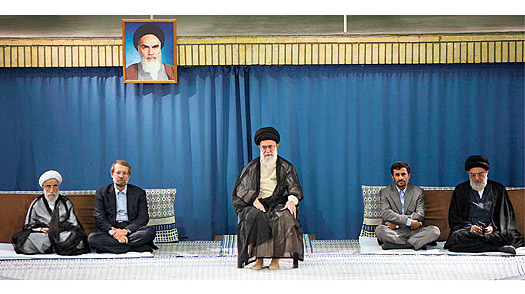
As turmoil spreads, the Supreme Leader taps one family to step in.
The swearing-in of a new chief judge normally receives scant attention in Iran. But the political intrigue spreading throughout the theocracy turned the Aug. 17 ceremony for Sadegh Larijani into a happening dissected across the country and around the world. There was President Mahmoud Ahmadinejad, flanked on one side by the new chief judge and on the other by Sadegh's elder brother Ali Larijani, the speaker of parliament. With two of the three government branches now under their control, the Brothers Larijani have become a counterweight to Iran's eccentric President--with the full endorsement of Iran's Supreme Leader, Ayatullah Ali Khamenei.
Often referred to as Iran's equivalent of the Kennedy clan, the five Larijani brothers--all bearded, sandy-haired and bespectacled--have spent the past three decades consolidating their power. They've run for the presidency, won Cabinet posts, served on the Council of Guardians and Assembly of Experts, directed state broadcasting, headed the Supreme National Security Council and served as deputy commander of the Revolutionary Guards. Now the Supreme Leader is tapping into their experience and loyalty to prop up the troubled regime, as the focus of public disgruntlement shifts from the disputed June 12 presidential election to Khamenei's powers. "The Supreme Leader is looking for people to support him. He is also looking for balance to Ahmadinejad," says Mohsen Kadivar, an Iranian reform cleric. "There are now two different currents among conservatives: one, Ahmadinejad and the Basij [paramilitary zealots], and the second, like the Larijanis, who are more rational and pragmatic."
After 10 weeks of unrest, criticism of the regime is growing. Dozens of clerics have issued an unsigned 11-page letter, posted on several websites, calling Khamenei a dictator and demanding his dismissal. A group of ex-lawmakers publicly blamed Khamenei for the postelection turmoil and demanded a public probe by the Assembly of Experts that selected him. And public fury is growing over the alleged rape of detainees as well as the show-trial purges of opposition figures, many of whom once ran Iran's government.
The Larijanis' rise reflects the narrowing of power in Iran. Although the 1979 revolution shed 2,500 years of monarchy, Iranian politics is still often family based. During the reform era of President Mohammed Khatami, his brother Reza was deputy speaker of parliament. His Culture Minister was married to a member of parliament. Former President Ali Akbar Hashemi Rafsanjani's daughter Faezeh was a member of parliament, and his brother was head of the state-controlled radio and television (he was succeeded by a Larijani).
But no family has held as many positions in so many branches of Iran's labyrinthine government as the Larijanis. Mohammad Javad Larijani, a Berkeley-educated mathematician and the eldest, has been a member of parliament, a Deputy Foreign Minister and an adviser to the Supreme Leader; Bagher Larijani, a physician, has served as Deputy Minister of Health; and Fazel Larijani, a diplomat, spent years posted in Ottawa.
Ironically, the Larijani family patriarch was hardly a politico. The late Grand Ayatullah Mirza Hashem Amoli spent decades in Iraq, where some of his sons were born, and was a "quietist" who took the traditional Shi'ite view that religion and politics should not mix.