

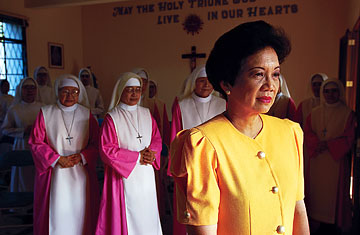
Aquino, pictured in 1995, stands with the "Pink Sisters," an order of nuns who gave her sanctuary during the 1986 revolution
(2 of 2)
Filipinos saw her as that leader, but she declined the role until December 1985. It was then that a Marcos-controlled court acquitted the military men accused of killing Benigno. Marcos then decided to hold a snap presidential election to reaffirm his mandate.
Though hampered by the government's near monopoly of the media, the Aquino campaign attracted millions of fervent supporters, all decked out in yellow, the reluctant candidate's favorite color. And when Marcos cheated her of victory in the February 1986 vote, the outcry was tremendous — and his doom was sealed. Bearing witness to their political allegiance, the millions who crammed the streets to protect reformist soldiers who had mutinied against Marcos chanted the now familiar mantra: "Cory, Cory, Cory." Nuns armed only with rosaries knelt in front of tanks, stopping them in their tracks.
It was the first revolution to be fully televised. By way of 24-hour cable news, the world witnessed four days of the military-civilian rebellion, a preview of similar uprisings that would later shake out the autocracies of Asia, Latin America, Eastern Europe and the Soviet Union. In a sweep of U.S. helicopters, Marcos was whisked off to exile in Hawaii, and Aquino was proclaimed President of the Philippines. It was a most astonishing political story. Time named her Woman of the Year at the end of 1986, the first female to hold Time's annual distinction on her own since the newly crowned Queen Elizabeth II in 1952.
God and Governance
To govern the Philippines, she would need all the goodwill she could muster. The country was one breath away from the economic morgue, while Manila's brand of democracy was built on reeds. Aquino survived eight coup attempts by plotters who hoped to head off her liberal constitution and the return of a bicameral Congress. She took pride in her fortitude. "I have to project my confidence even more than some men do," she said early in her presidency. "No one can say that Cory did not give it her all."
Aquino was convinced that her presidency was divinely inspired, even as her political foes mocked her piety. "If the country needs me," she said, "God will spare me." And miracle of miracles, she proved God right and her critics wrong. She would be succeeded by a democratically elected general — the first to be at her side as Marcos threatened to mow down her supporters in the streets. She anointed him despite the opposition of her church. Indeed, Fidel Ramos would be the first Protestant to lead the overwhelmingly Catholic country. And he would give the islands a taste of stability and economic prosperity that she was unable to deliver. But without her withstanding the enemies of freedom, he would never have had the chance.
After the presidency, she basically returned to keeping house and watching over her husband's legacy. But every now and then she would emerge from private life to tell her successors to behave. She helped lead a second People Power uprising to depose the inept government of Joseph Estrada; she also led protests against her former ally, the second woman President of the Philippines, Gloria Macapagal Arroyo, to warn her against rewriting the constitution to extend her time in office.
Whenever the country appeared to be in a crisis, Cory Aquino rose above the bureaucratic procrastination that had always bogged it down, reminding her people that they once astonished the world with their bravery — and that they could do it again. But Filipinos must now take stock. Whom will they march with now that their saint has gone to meet her God?