

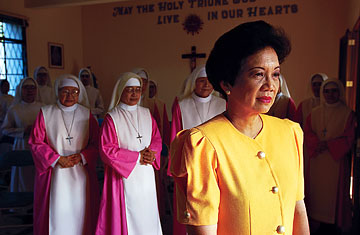
Aquino, pictured in 1995, stands with the "Pink Sisters," an order of nuns who gave her sanctuary during the 1986 revolution
The arc of Corazon Aquino's life lent itself to maxims, but two hard-nosed ones seem particularly worth pointing out. First, political sainthood is a gift from heaven with a Cinderella deadline — once past midnight, you are a pumpkin. Second, personal virtues are never a guarantee of effective or successful governance. What was truly shocking about Aquino's tumultuous six-year term as President of the Philippines was that those maxims proved untrue. Midnight always threatened Aquino but never struck; and she was a good woman whose goodness alone, at the very end, was what proved enough, if only by an iota, to save her country.
The exact opposite was foretold by the husband whose murder she vowed to avenge and whose political legacy she promised to preserve. Anyone who succeeded Ferdinand Marcos, Benigno Aquino declared, would smell like horse manure six months after taking power. The residual effects of the dictatorship of Marcos and his wife Imelda, he said, could guarantee no success — only disaster, despair and failure.
But after a popular rebellion in 1986 overthrew Marcos and proclaimed her President in his stead, Benigno Aquino's widow lasted more than six months; indeed, she lasted her entire six-year term. Furthermore, she retained a whiff of sanctity even as her government rotted, even as Filipinos worked hard to prove George Orwell's aphorism that saints are guilty until proven innocent. As Aquino ruled, every month seemed to diminish the political miracle of her astonishing rise to power, but she survived. And her survival guaranteed the continuation of democracy in her homeland.
The Philippines is still a raucous political hothouse. And every now and then it seems to return to the brink. But the dire days of deadly coup plots are over. At the end of her life, as she engaged in an excruciating battle with cancer, Corazon Aquino was the most revered figure in the Philippines. The country took out its yellow ribbons once again, bedecking trees and lampposts and even Facebook pages with the symbol of her revolution. And when she died, the Philippines and the world were reminded of the exemplary days of courage that she had embodied, the People Power uprising that would become a model for mass revolt at the end of the 20th century and into the 21st.
An Unlikely Icon
Corazon Cojuangco was born into one of the wealthiest families in the islands. Fated to be married off in one dynastic match or the other, she was courted by and fell in love with Benigno Aquino Jr. — known by his nickname Ninoy — a brilliant and ambitious journalist turned politician whose own family was as illustrious though not quite as wealthy as her baronial clan. The marriage would help propel Ninoy's career even as Cory became a cipher at his side, the high-born wife whose social ministrations at smoke-filled political sessions flattered her husband's supporters. Ninoy's popularity soon challenged Ferdinand Marcos, who had been elected President in 1965. And so, when Marcos assumed dictatorial power in 1972, he threw his rival into jail. Corazon then became her husband's instrument, smuggling messages out of prison and raising funds for the opposition. But as long as he lived, Cory was merely an extension of Ninoy.
All that changed on Aug. 21, 1983, when Ninoy Aquino returned to the Philippines after three years of exile in the U.S., only to be shot dead even before he could set foot on the tarmac of Manila's international airport. Filipinos were outraged, and suspicion immediately fell on Marcos. At his funeral, mourners transformed Corazon into a symbol.
The devout and stoic Roman Catholic widow became the incarnation of a pious nation that had itself suffered silently through more than a decade of autocratic rule. Millions lined the funeral route and repeated her nickname as if saying the rosary: "Cory, Cory, Cory." If she had agreed to let the massive demonstrations of outrage pass in front of the presidential residence, Malacañang Palace, said Vicente Paterno, a Marcos official who would later be her ally, "that could have toppled Marcos." But it would be nearly three years before she would learn to take advantage of her power. Instead, she concentrated on the fractious opposition, using her moral influence to help it choose a leader to oppose Marcos.