

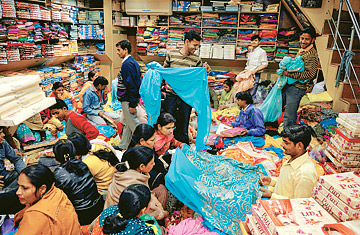
Shoppers visit a sari store in Delhi's Chandni Chowk bazaar
I am standing in Dilli Haat, New Delhi's popular open-air handicrafts market, feeling a little guilty. My usual uniform for a hot summer evening--jeans, sandals and a comfortable cotton tunic--is putting people out of business.
"People in Delhi have abandoned their own traditional clothing," says Bilal Ahmed, 24, a sari weaver who works for his family business in Jammu and Kashmir. "People don't buy saris anymore. Now they buy jeans."
Ahmed has been working in the sari business for the past 13 years. During that time, the attire's popularity has declined drastically among women in India's cities. The sari industry is composed mostly of small-scale businesses, so there are no comprehensive statistics to track sales. But observers say that as sartorial tastes have changed, this centuries-old emblem of Indian culture has fallen out of fashion. The market for handloomed saris--simple cotton garments, usually with plain designs and muted colors, that many Indian women used to wear daily--has been particularly hard hit. "Sari?" giggles Rashmi Raniwal, a 22-year-old sales assistant. "I never wear it casually. Only for formal occasions."
Sari sales do pick up during the winter, Delhi's high season for lavish parties and weddings. But fashionable young women favor designer saris made on power looms over traditional handwoven silks like the ones in their mothers' cabinets. "Who wears traditional saris anymore?" asks Deepa Nangia, 36, a nutritionist who calls herself a "sari freak." In her circle of friends, she says, she is the only one who wears saris at all. "I think it's just gradually dying out with time."
The most prized sari styles--made of Banarasi or Kanjeevaram silk--are also facing stiffer competition. Depending on the intricacy of the design, it can take 15 to 30 days to weave just one of these garments, which sell for $50 to $60 apiece. The hefty price and painstaking procedure have left manufacturers vulnerable to competition from knockoffs produced on power looms and from cheap Chinese imports. "The industry is facing lots of difficulties," says Abdul Basit Ansari, 37, a Banarasi-silk weaver who has been making the garment for 20 years.
Sarimakers are struggling even in South India, where saris are much more popular. In the district of Kanchipuram, near Chennai, the number of weaver cooperatives has fallen from 22 in 2004 to just 13, according to the Indian magazine Business Today. Of these, only five say their business is prospering. Total annual sari sales plunged in 2008 to $12 million, down from $40 million in 2004. The best-known sari shops--like Nalli, which boasts gleaming showrooms in several big Indian cities--have contracts with Kanjeevaram-weaver co-ops, which helps them hang on. But that's not enough to stop people from fleeing the profession. In and around the district of Kanchipuram, famous for its silk saris, the number of weavers has slipped from 60,000 10 years ago to about 20,000 today.