

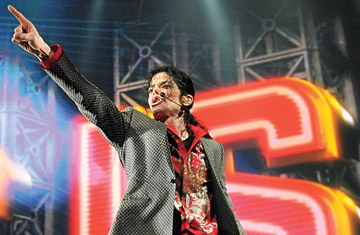
Pop star Michael Jackson rehearses at the Staples Center in Los Angeles on Tuesday, June 23, 2009.
(4 of 5)
Jackson had hoped to star in a Steven Spielberg film of the James M. Barrie play Peter Pan, about the boy from Neverland who refuses to grow up. The story's reflection of his own needs, dreams and scars was poignant. In a tearful (and top-rated) interview with Oprah Winfrey, he confessed that his father had beat him and called him ugly (this beautiful child!). Who wouldn't want a makeover of that scarred youth? Once he had the money and power, the perpetually preadolescent Jackson moved into a fantasy version of childhood, in the company of young boys he saw as his peers and saviors. Asked by Winfrey what he missed most in his own youth, he replied, "Slumber parties." He'd make good on that wish, bunking with kids his own emotional age.
One of those boys brought a child-molestation suit against Jackson, which consumed the tabloids, subjected him to a penis examination and ended only when he settled with the boy's family for a reported $20 million. In 2003, Jackson was charged with child molestation in criminal court. At his trial in 2005, he proclaimed his innocence, once showing up in court in his pajamas. The jury agreed with him. He was never convicted of anything, except terminal weirdness, by a public for whom Jackson was less famous than notorious.
This Peter Pan died just as he was showing signs of adult behavior. In 2005, Jackson saw Ron Burkle, the billionaire chairman of Yucaipa Cos., at the funeral of Johnnie Cochran, who had defended Jackson. Burkle, a person close to the matter told People, "told him in a very honest way that he kind of had to grow up, and as an adult, you have to start paying attention to where your money is going. Ron advised him to cut his spending or go back to work." Jackson sold Neverland to a partnership run by Colony Capital, a private-equity firm, and moved to the ultra-posh Holmby Hills in West L.A. Burkle's counsel was sensible, free and friendly, and it more than likely saved Jackson's wealth. He even paid for forensic accountants to untangle Jackson's finances. The Gloved One began writing his own checks. But even with cutbacks, Jackson needed income to maintain his lifestyle. That would mean performing; he hadn't toured since 1997. So he reluctantly agreed to a London gig that would eventually grow to 50 shows. He had already sold over $90 million worth of tickets. The aging King of Pop was primed for a comeback.
Now his realm will be open for inspection and vandalism by any number of interested parties and their lawyers. A will Jackson signed in 2002, made public after his death, leaves his estate to a family trust and nothing to Debbie Rowe, his second wife and the mother of Prince Michael Jackson, 12, and Paris Jackson, 11. A third child, Prince Michael II, 7, was born to an unidentified surrogate mother. The star's mother Katherine is named as a beneficiary to the trust and guardian of the three children. But they won't see their inheritance, if any, until the debt issues are resolved. "You have to pay your creditors before you can pay your children," says Robert Rasmussen, who teaches contract law at the University of Southern California. "That's Law 101."