

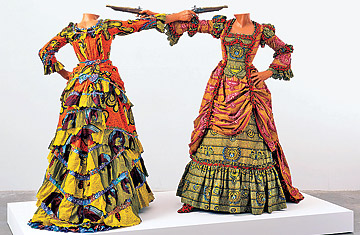
How to Blow Up Two Heads at Once (Ladies), 2006
Even by the standards of a globalized world, you won't find many artists more transnational than Yinka Shonibare. He was born in the U.K. of Nigerian parents, spent his childhood shuttling between London and Lagos and, for the past decade or so, has been one of those international figures whose work turns up, often accompanied by its creator, on every continent.
Four years ago, when Queen Elizabeth II made Shonibare a Member of the Order of the British Empire (MBE), his leftist friends expected him to turn the award down. Instead, he just about bolted the letters MBE to his name, but with a very broad wink. "I was always part of the empire," he says. "Now I've been officially incorporated by it."
This helps explain why his cartwheeling midcareer retrospective, which just opened at the Brooklyn Museum in New York City, is called "Yinka Shonibare MBE." The show, which originated last year in Sydney and moves on in November to the Smithsonian's National Museum of African Art in Washington, presents us with the work--sculpture, paintings, staged photographs and two short films--of a man who is both a consummate product of colonial empire and a shrewd decoder of its false assumptions.
Shonibare is best known for making headless mannequins like the ones in his How to Blow Up Two Heads at Once (Ladies). They come outfitted in 18th or 19th century dress, but in a wild-style fabric that's from another time and place altogether. It looks at first like "traditional" African patterned cloth--and it is--but the tradition turns out to be complicated. As Shonibare discovered years ago, those "African" wax-print textiles are actually produced by the Dutch, who borrowed them from the batik cloth of their Indonesian colony, then started selling them in Africa, where they were adopted as, ahem, native dress. "Even things that were supposed to represent authentic Africa," he says, "didn't turn out to fulfill the expectation of authenticity."
But as a symbol of the unstable elements that go into racial and national identities, the cloth was perfect--and it was also gorgeous. Shonibare set to work using it for his signature mannequins. Dummies in more ways than one, his headless figures are oblique meditations on the complexities of cultural identity, coming at the question from the indirect angles provided by wit, ambiguity and beauty. In his ensemble piece Scramble for Africa, the 14 life-size figures arranged around a table represent the colonial powers that carved up Africa at the Berlin Conference of 1884-85, where they helped themselves to what King Leopold II of Belgium called a "slice of this magnificent cake." But in their eye-sizzling faux-African costumes, the figures offer themselves to us in the crazy plumage of the future their colonialist misadventure will create, a world so teeming and cross-pollinating that it's well beyond their grasp. And beyond ours too, though we like to tell ourselves otherwise.