

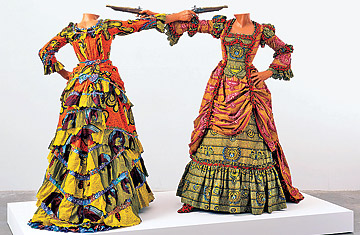
How to Blow Up Two Heads at Once (Ladies), 2006
(2 of 2)
That's a world Shonibare was born to navigate. At the time of his birth, in 1962, his father was a law student in London. When Shonibare was 3, his family moved back to Nigeria, but they returned to London in the summers. In Lagos, the future artist spoke English at school but Yoruba at home. At the end of the workday, his father changed from Western dress into African robes. "Being bicultural for a Nigerian is completely normal," Shonibare says. "There's nothing strange about it."
In the early 1980s, Shonibare returned to England to attend the Wimbledon College of Art, but he had been there only a few weeks when he collapsed one day in class. The cause turned out to be transverse myelitis, an inflammation of the spinal cord, which for a time left him largely paralyzed. Now he can walk again, though with difficulty.
His disability hasn't stopped him from roaming freely through history. As another way of toying with the idea of cultural identity, Shonibare has featured himself in staged photographs, including a series that draws on Oscar Wilde's novel The Picture of Dorian Gray. This time it's Shonibare as the man who shows a false face to the world. But as he would be the first to ask, in a world so full of falsehoods, what other kind can there be?
Steady Art Beat Richard Lacayo blogs daily about art at time.com/lookingaround