

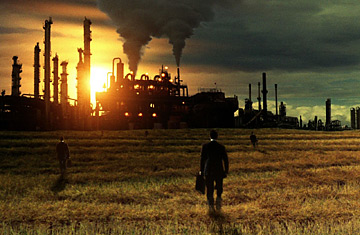
Food, Inc. shows how America's edibles changed as the nation journeyed from agrarian to industrialized.
(2 of 2)
The emotional anchor of the film is a lifelong Republican named Barbara Kowalcyk, who has been lobbying on behalf of food safety since she lost her 2-year-old son Kevin to E. coli after he ate tainted ground beef. (In 2007, 73,000 people were sickened by the E. coli bacterium, one of many chilling statistics cited in the film.) She's a steady woman of few words, but the ones she uses to convey her anguish are devastating: "He begged for water," she remembers of her child's 12-day struggle to stay alive. Since 2002, she has lobbied--unsuccessfully to date--on behalf of Kevin's Law, which would allow the USDA to close plants that have repeatedly turned out tainted products, a power the agency began wielding in 1998 and lost in 2001 after being taken to court by the meat and poultry associations.
The people we don't hear from are those who control the U.S. food industry. The film takes us to meat-processing plants and slaughterhouses (sometimes with hidden cameras), offering glimpses of chickens collapsing under the weight of their own breasts or the truly revolting production of bleached hamburger "filler." But nearly every time Kenner asks a corporation such as Perdue, Smithfield or Monsanto for comment, he's refused.
Only Wal-Mart is represented on camera, taking a careful, profit-conscious step toward selling organically produced foods. The company's executives earn points for smiling through a farmer's gleeful pronouncement that she boycotts the store. That they, along with Stonyfield Farm organic-yogurt mogul Gary Hirshberg, come off favorably might not sit well with Pollan, who devoted a damning chapter to what he calls "Big Organic." But there need to be bright signs in a film like this, if only to allow its hopeful message to get through. As Pollan writes (on page 257 of Omnivore--the film gave me courage to finish), "We can still decide, every day, what we're going to put into our bodies, what sort of food chain we want to participate in." And as the movie demonstrates, we can vote at the market or even with the gardens we plant.
Speaking of which, if a certain lady in Washington with an organic garden, who happens to be married to a guy who loves a hamburger, would like a screening of Food, Inc., Kenner would probably be happy to oblige.
The original version of this story wrongly characterized E. coli as a virus. It is a bacterium.